Incoming invoice list

Learn how to list, search and manage incoming invoices received from suppliers in Logzi.

Function overview

In this module you can review and manage Incoming invoice documents. The incoming invoice is the base document of procurement: you record on it the data of the invoice received from the supplier, that is, what you bought, from whom, at what price and under what payment terms. The list shows all recorded incoming invoices in one place, lets you search among them, and is the starting point of the most important actions (recording a new invoice, closing, cancellation, settlement, sending an email, printing, downloading, creating a warehouse receipt).

The screenshots in this guide were taken in the Hungarian interface; the Hungarian labels are given in parentheses in the captions.

  • Clear list: invoices appear in a paginated table by document number, dates, partner, amount, settlement and status; below the table a summary row is shown per currency.
  • Quick actions: with one click you can open, close, cancel, copy, settle or download the selected invoice without having to enter every invoice.
  • Preview window: below the list you can immediately see the items and related data of the selected invoice without leaving the list.
  • Customisable view: you can set which columns are displayed, how many rows are shown on a page, and the order in which the system sorts the data.
  • Analytics: the Analytics link in the top right corner of the list leads to the statistics page of incoming invoices.

The possible states of Incoming invoice documents are: Draft, Closed, Cancellation, Cancelled — the meaning and restrictions of each state are detailed in the Frequently asked questions section. Besides the main list, the Procurement / Incoming invoices menu contains separate views: the list of Expiring incoming invoices, Online incoming invoices and Email invoices.

Step by step

1. Viewing the list and the actions available on invoices

Click Main menu / Procurement / Incoming invoices / List and all recorded incoming invoices appear. Above the table, on the Actions tab, you can work with the selected invoice using the following buttons:

  • New: record a new incoming invoice on an empty sheet — choose it when you want to enter the data of the supplier invoice manually.
  • Open: open the detailed view of the selected invoice to edit the items and header data (for a closed invoice, only to view it).
  • Close: finalise the invoice, optionally with immediate printing (Close and print) or download (Close and download) — available only for an invoice in Draft state.
  • Cancellation: cancel the invoice. Besides Cancellation, the dropdown also contains Cancel and copy (creates a copy next to the cancellation, so you can restart a wrongly recorded invoice in one step) and Permanent deletion (available only for invoices already in the cancelled state). When you start the cancellation you have to enter the number of the cancellation invoice (see the Frequently asked questions).
  • Cloning: create a new incoming invoice from the data of the selected one — faster than retyping everything for similar invoices coming from the same supplier.
  • History: view the documents related to the selected invoice.
  • Settlement: record the settlement of the invoice — in the dropdown you can choose between Bank document, Bank transaction and Settlement. The Cash register document option is currently not selectable. The Settlement command is available for an invoice in Draft or Closed state, the other options for a closed invoice.
  • Send email: send the closed invoice by email.
  • Download: export the list or the selected invoice — in the List operation group XLSX list, XLSX item list and XLSX item list grouped, in the Document operation group XLSX items, XLSX items grouped and XLSX serial number list, as well as PDF (for a closed invoice), PDF preview and Download attachments for the invoice.
  • Print: print the selected invoice directly (Document, for a closed invoice) or print the Product label for its items.
  • Document management: create a new related document from the invoice or modify the invoice (see below).

The icon in the top right corner of the list copies the content of the table to the clipboard, so you can paste it into a spreadsheet, for example. The same quick actions are also available from the context menu that opens when you right-click an invoice row.
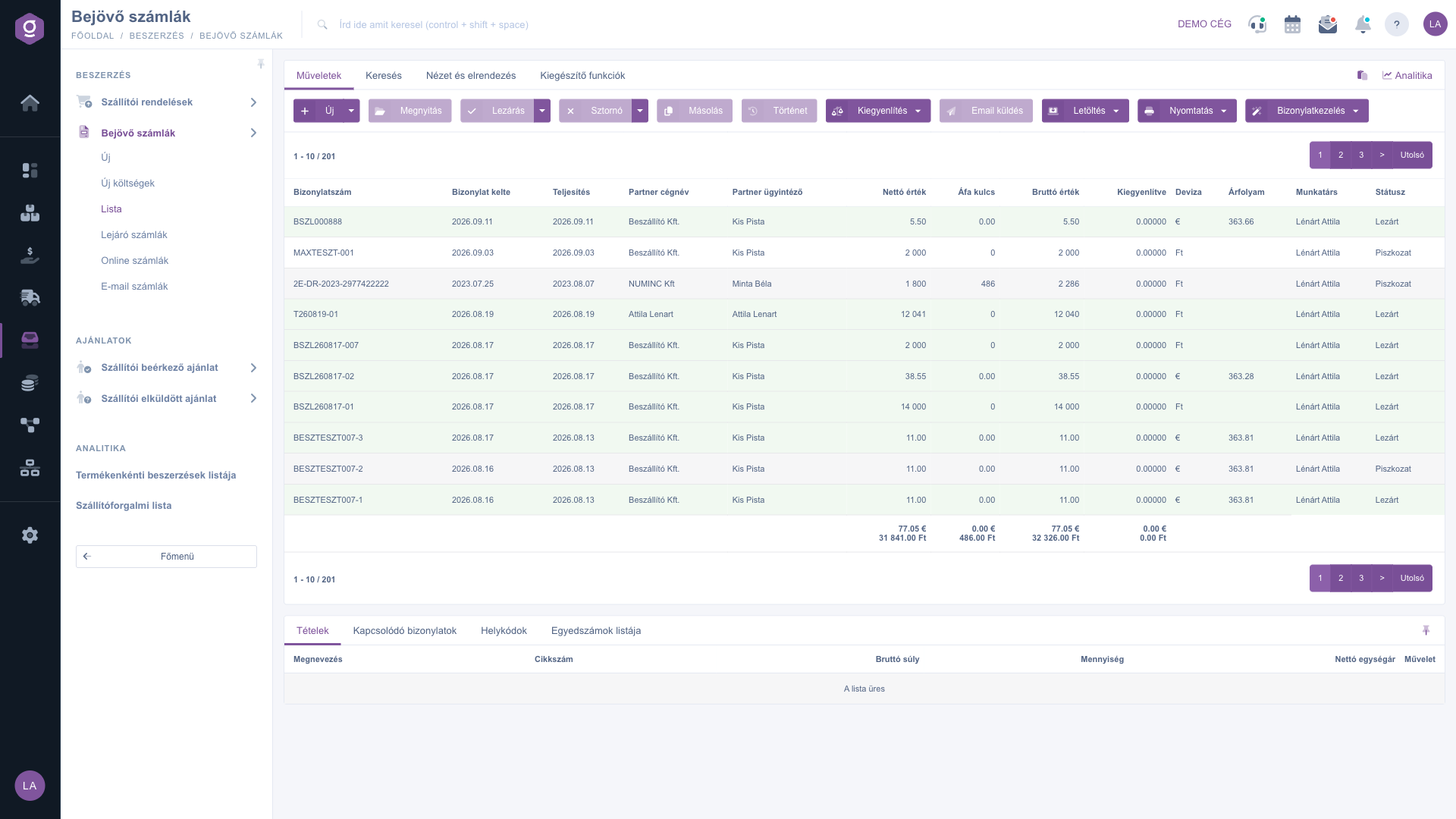
Incoming invoice list – Actions tab (Műveletek)
Attention: the Settlement command started from the list immediately records a full-amount settlement dated today, without a separate window or confirmation. If you want to settle a partial amount or change the date, open the invoice and use the Settlement window described in the Incoming invoice sheet guide.

Document management: a new document based on the invoice

The dropdown of the Document management button creates a new related document from the selected invoice or modifies the invoice:

  • Warehouse receipt: start a new warehouse receipt document based on the closed incoming invoice (see the Warehouse receipt document guide).
  • Worksheets: start a new worksheet related to the closed invoice.
  • Modification: cancel and copy the invoice in one step — available for an invoice in closed or cancellation state, for correcting a wrongly recorded invoice.
  • Cloning: start a new incoming invoice with the data of the selected invoice.
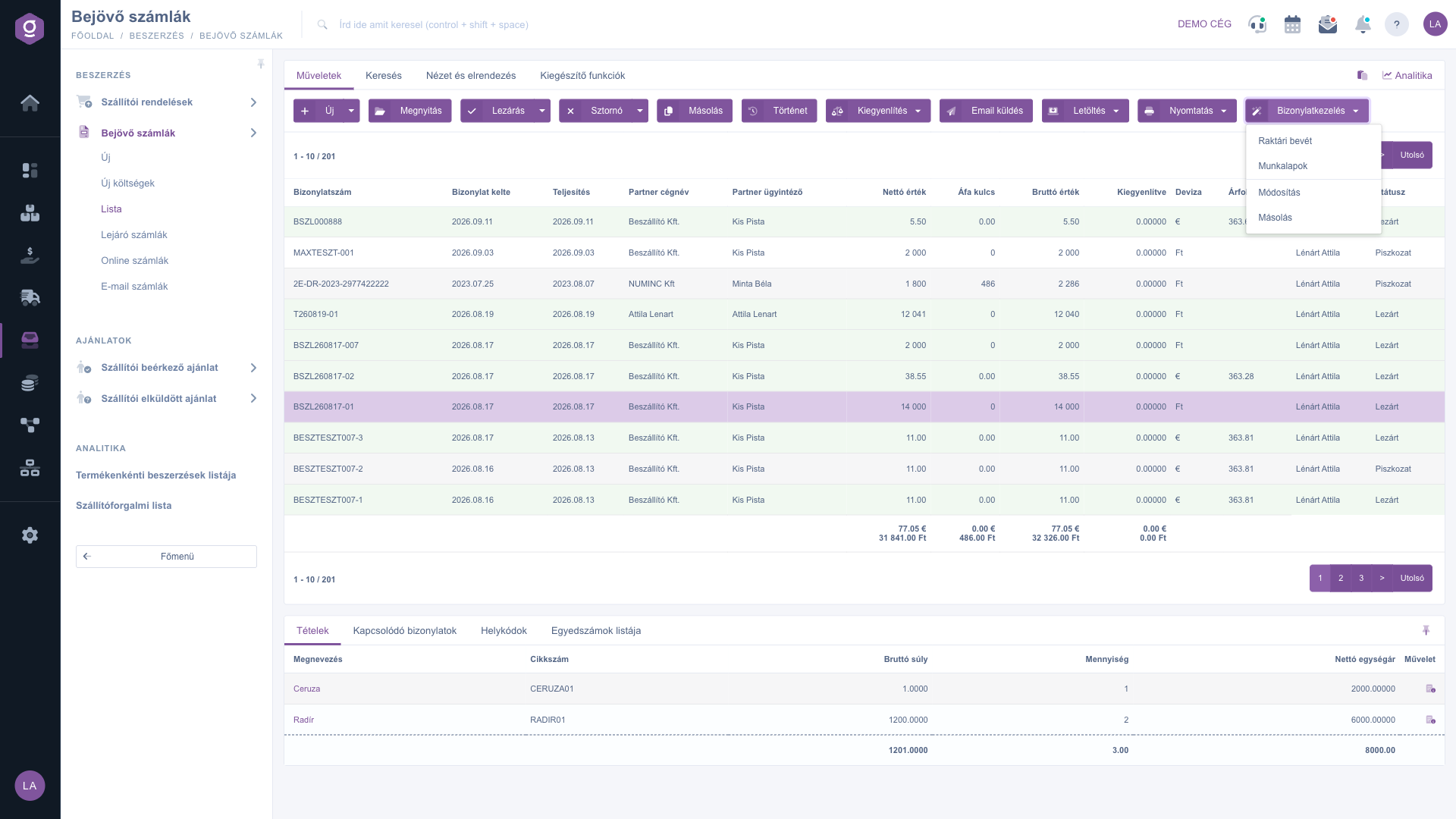
Incoming invoice list – Document management menu (Bizonylatkezelés)

Download and print

The Download menu is divided into two groups: the commands of the List operation group export the entire list currently visible (even without a selection), the commands of the Document operation group apply to the selected invoice. The PDF preview shows the invoice without downloading it.
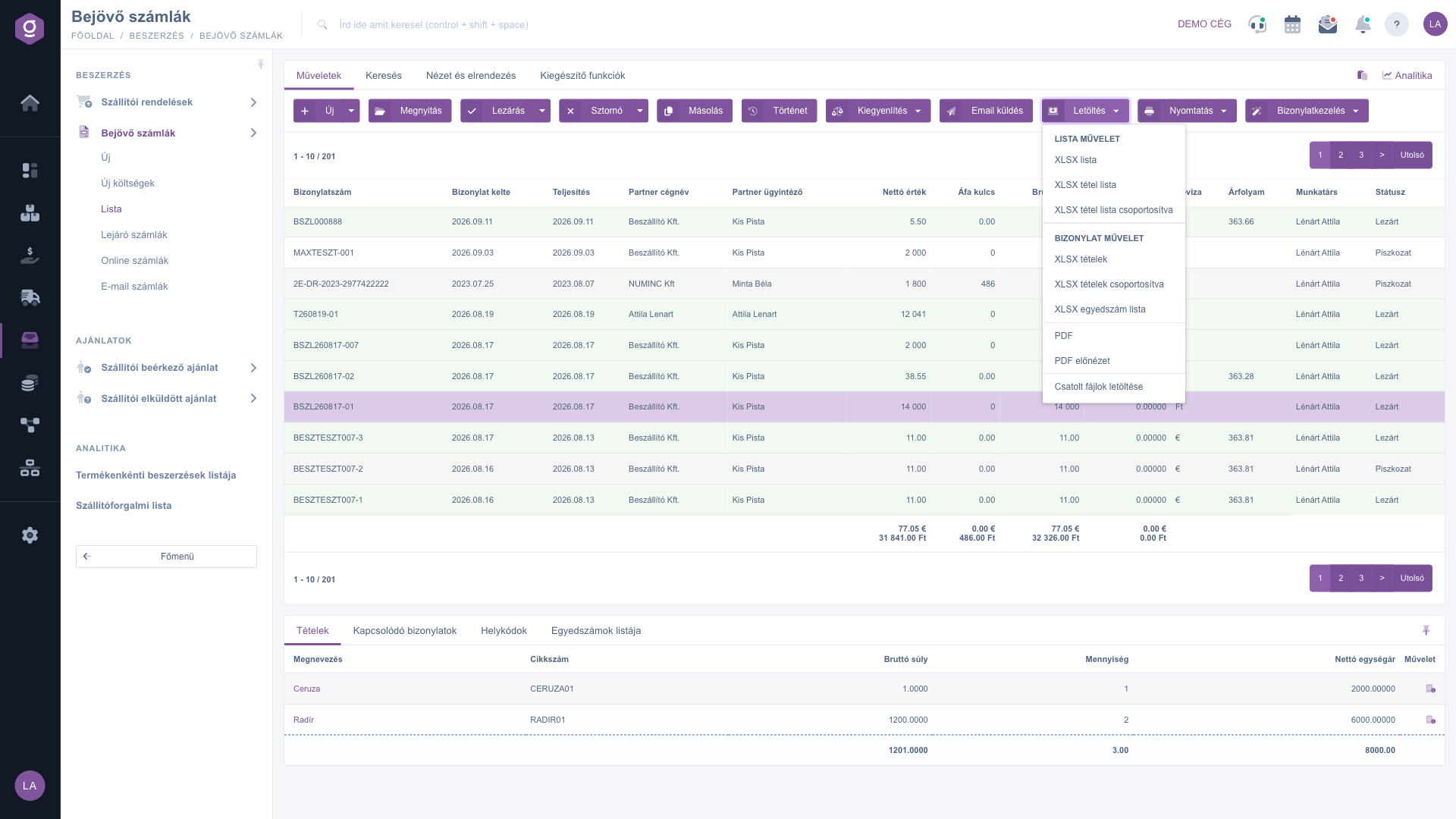
Incoming invoice list – Download menu (Letöltés)

Searching among the invoices

Click the Search tab above the table to display the filtering options. The most frequently used fields are visible right away: Partner company name, Document number, Currency, Status (several values can be selected) and Settled (Yes / No). The Expand button opens further, more detailed filters: searching by date in the Document date, Performance date, Due date and Settlement time fields, and filtering by Payment method (several values can be selected), Employee, Item number, Project, Job number and Department number. You can apply the set conditions with the Search button; a separate icon saves the search and another deletes the saved search, and the saved search is loaded automatically the next time you open the list.
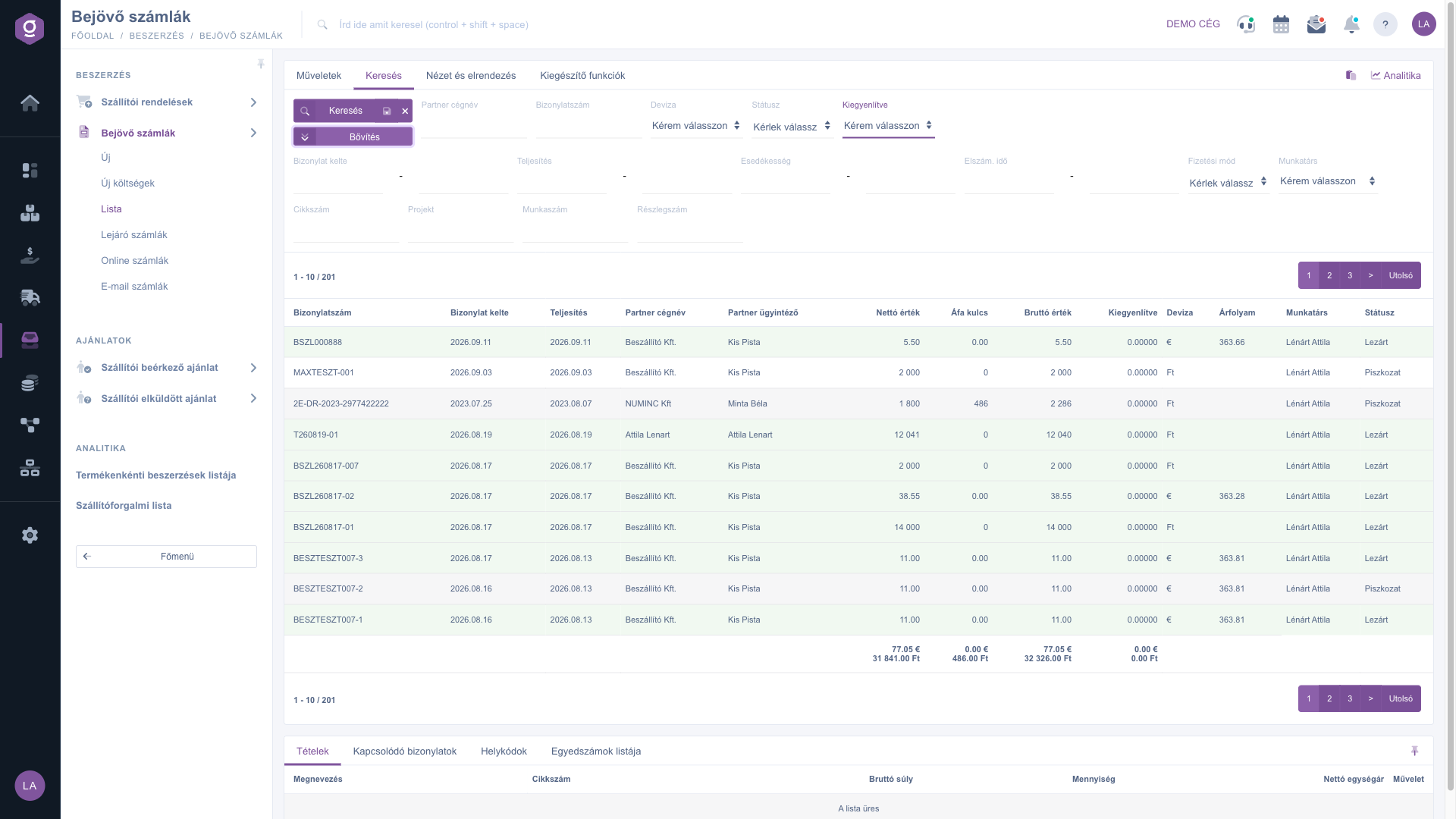
Incoming invoice list – Search tab, expanded (Keresés, Bővítés)

Customising the view

On the View and layout tab you can set how the list is displayed:

  • Columns: choose which fields appear in the table.
  • Rows (Sorok): set how many invoices are shown on one page.
  • Sorting: decide by which column and in which direction the system sorts the list by default.
  • Preview window: turn the preview panel below the list on or off and pin it (see below).
  • Interface and behavior: further settings related to the appearance of the list.

These settings are saved for your user, so they are kept the next time you sign in.
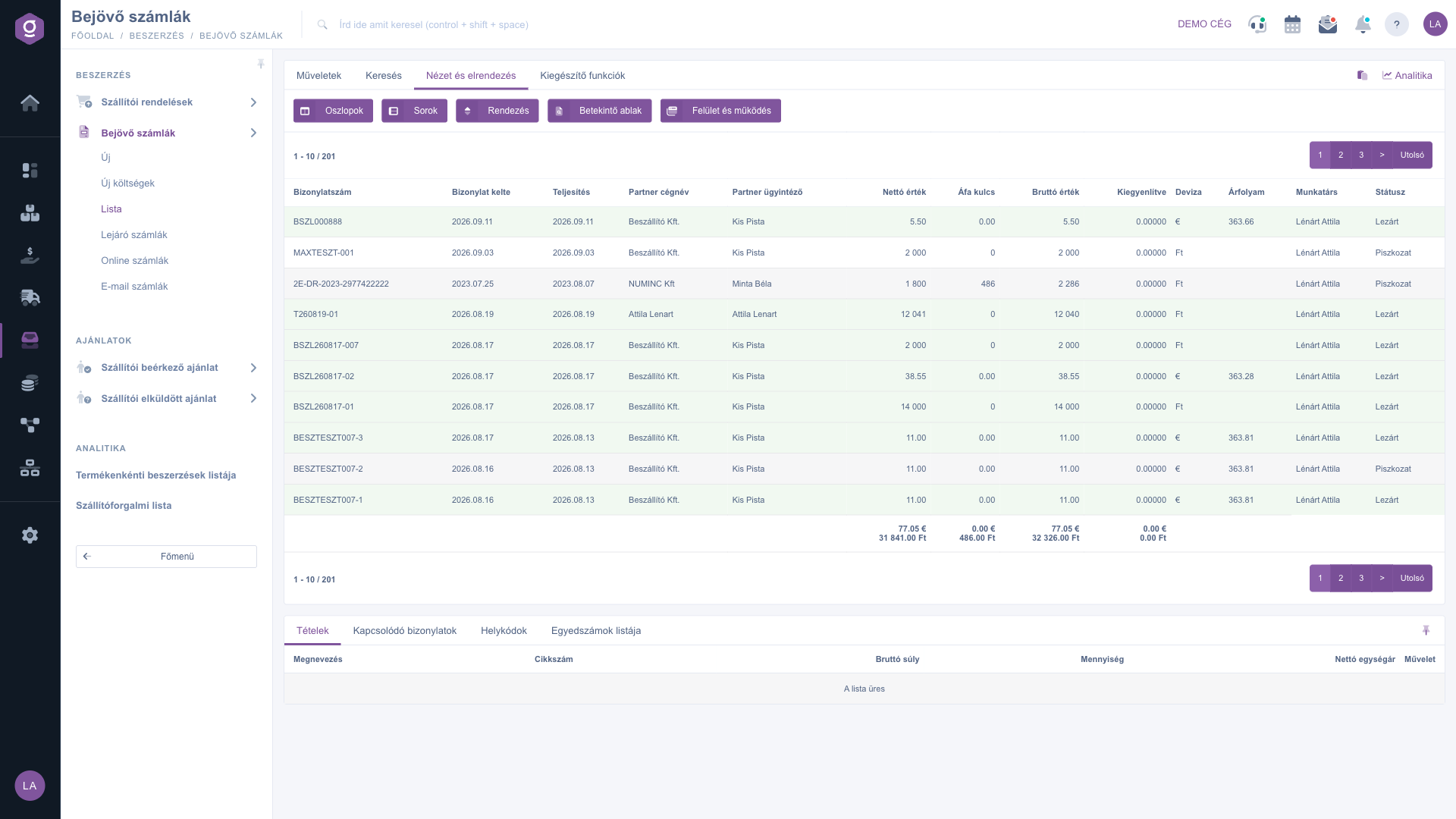
Incoming invoice list – View and layout tab (Nézet és elrendezés)

The preview window

The panel displayed below the list lets you quickly review the data of the selected invoice without opening it. The panel contains several tabs:

  • Items: the products, quantities and prices on the invoice.
  • Related documents: other documents related to the invoice.
  • Location codes: the warehouse locations, warehouse and pallet data of the items.
  • List of serial numbers: the breakdown of the unique identifiers recorded for the items (e.g. serial number, shelf life).

The Location codes and List of serial numbers tabs appear only if these functions are enabled for your company. The panel can be pinned (set to a fixed size) with the icon in its top right corner, and you can change its size by dragging the divider at the top of the panel.
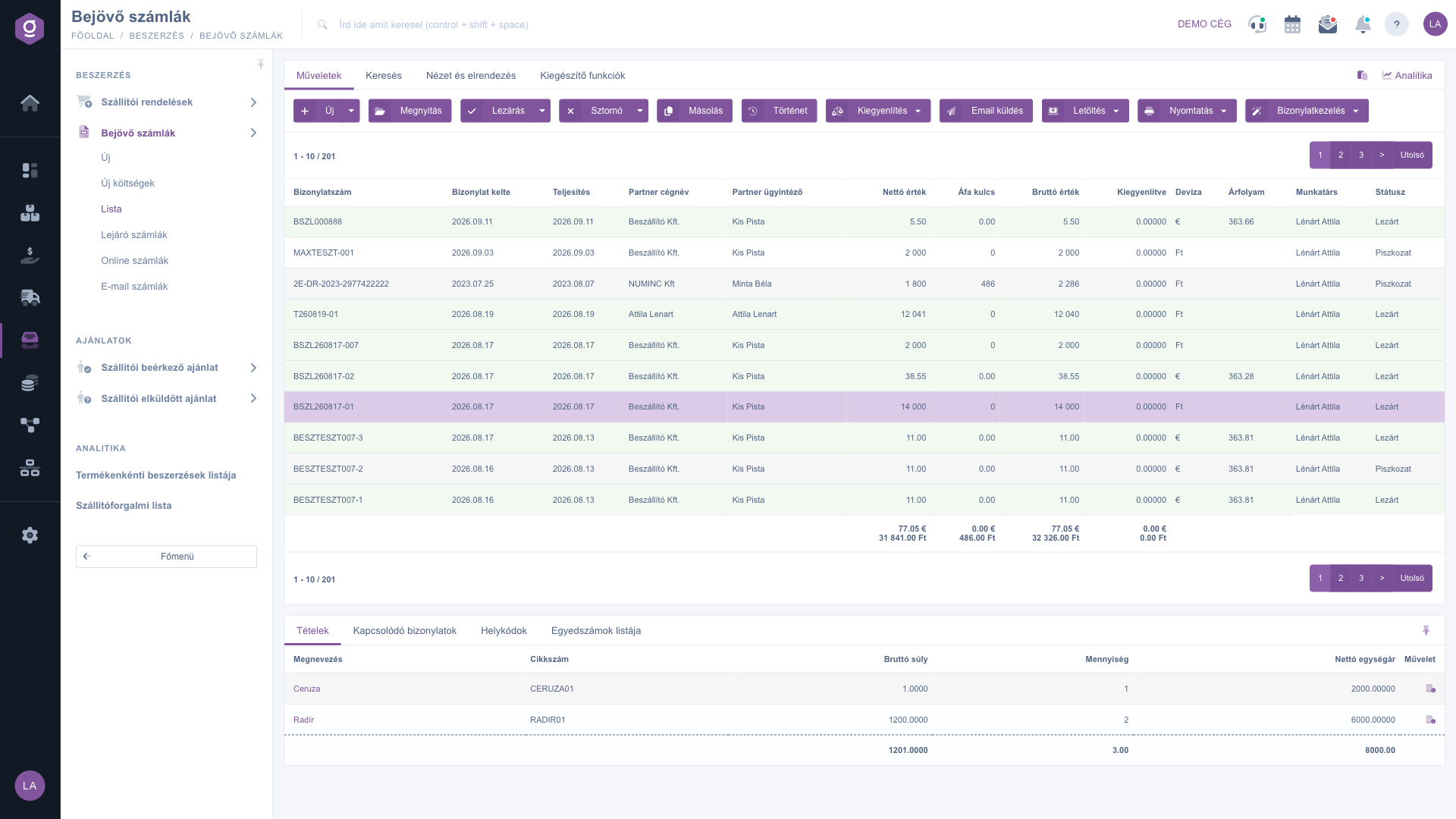
Incoming invoice list – selected invoice and the preview window (Betekintő ablak)

Additional functions

The Additional functions tab offers extra options related to the selected invoice that help your daily work:

  • Sent items: view the emails previously sent for the invoice.
  • New email: write a new email related to the invoice using the External mail client or the Internal mail client built into the system.
  • New task: create a task related to the invoice.
  • Partner card: open the detailed record of the partner on the invoice.
  • CRM: view the customer relationship notes recorded for the partner.
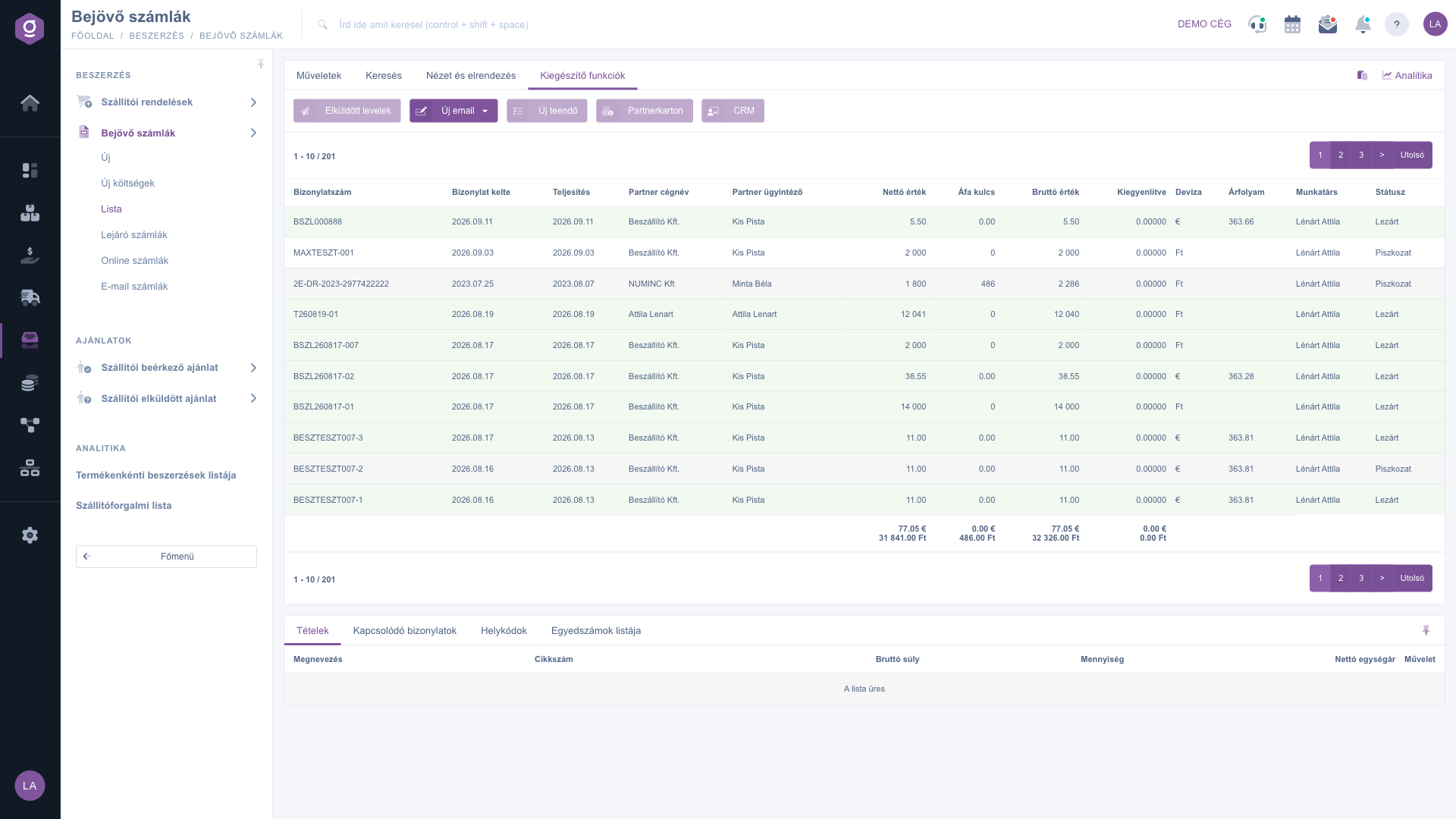
Incoming invoice list – Additional functions tab (Kiegészítő funkciók)

Tip


If you want to find out which supplier invoices you have not paid yet, use the Settled filter (No) on the Search tab and select the Closed state in the Status field. The list then shows only closed invoices that have not been settled yet, and you can export them straight to a spreadsheet with the Download / XLSX list command.


To record a new incoming invoice or edit an existing one, see the Incoming invoice sheet guide. Recording non-invoice-type expenses is described in the Incoming invoice expense sheet guide, and tracking invoices close to their due date in the Expiring incoming invoices guide. For issued (outgoing) invoices, read the Invoice list guide.

Field descriptions

The default columns of the list and their meaning:

Field / Element Required Description
Document number The identifier of the incoming invoice, that is, the serial number written on the invoice by the supplier (e.g. BSZL260817-01).
Document date The issue date of the invoice.
Performance date The date on which the purchase was actually fulfilled.
Partner company name The name of the supplier (partner) who issued the invoice.
Partner contact person The name of the contact person on the partner side.
Net value The total net value of the invoice items.
VAT rate The total VAT amount of the invoice items (despite its name, the column shows the VAT value).
Gross value The total gross value of the invoice items, that is, the total amount payable.
Settled The amount of the invoice settled so far. If you have not recorded any settlement yet, the value is 0.
Currency The currency used on the invoice (e.g. HUF, EUR).
Exchange rate The exchange rate applied on the invoice, if the invoice was not issued in the company base currency.
Employee The name of the employee who recorded the invoice.
Status The current state of the invoice (Draft, Closed, Cancellation, Cancelled).

The set of displayed columns can be customised in the View and layout / Columns setting — the list above shows the default view. A separate file indicator column can also be selected among the columns.

The columns of the Items tab of the preview window and their meaning:

Field / Column Required Description
Name The name of the product or service on the item.
Item number The unique item number of the product, by which it can be identified in the master data.
Gross weight The total gross weight of the item (quantity × unit weight), calculated from the unit weight recorded in the product master data.
Quantity The purchased quantity in the unit of the product.
Net unit price The net purchase price per unit of quantity.
Action Quick actions for the row; in the preview window it is for viewing only.

Frequently asked questions

Closing finalises the invoice, so the items and header data can no longer be edited afterwards. If you find an error, you can cancel the invoice, or use the Document management / Modification command to cancel and copy it in one step, then correct the copy and record it again. With the Cloning function you can also start a new Draft invoice from a closed one.

The buttons are active depending on the state of the selected invoice. Close is available only for an invoice in Draft state. Send email, Bank document, Bank transaction, Warehouse receipt, Worksheets and Print / Document can be used only for a closed (or later-state) invoice, while the Settlement command works for an invoice in Draft or Closed state. Permanent deletion can be selected only for invoices already in the cancelled state. If no button is active, check whether you have selected a row in the table.

An incoming invoice is issued by the supplier, so the cancellation invoice is also sent by the supplier. When you cancel, the system asks for the serial number of the cancellation invoice with the message "A bejövő számla sztornózáshoz meg kell adni a sztornó számla sorszámát!" (to cancel the incoming invoice, you must provide the cancellation invoice's number); in the window the Cancellation invoice number field is prefilled with the original document number followed by the "-S" suffix, which you can overwrite with the real serial number received from the supplier. The details are described in the Incoming invoice sheet guide.

Cancellation only cancels the invoice. Cancel and copy also creates a copy next to the cancellation, and the Modification command of the Document management menu starts the same cancel-and-copy operation on a closed invoice. Permanent deletion no longer means cancelling: it removes an invoice that is already in the cancelled state permanently, so use it carefully.

The Settlement command immediately records the selected invoice as settled in its full gross amount with today's date, without a separate window. For partial settlement or another date, open the invoice and use the Settlement window of the sheet; for recording on the bank or cash side, use the Bank document and Bank transaction options.

Narrow the list to the required invoices on the Search tab, then use Download > XLSX list to export the entire list currently visible to a spreadsheet — even without a selection. If you also want the items of the invoices, use the XLSX item list or XLSX item list grouped command.

Under the Main menu / Procurement / Incoming invoices menu there are separate menu items: Expiring invoices (Expiring incoming invoices), Online invoices (Online incoming invoices) and Email invoices (Email invoices). This list shows the incoming invoices that have already been recorded.

The module appears in the menu only if it is assigned to your user. If it is missing, ask your company administrator to check the module assignment of your user.

Need personalized help?

Don't want to spend hours searching for a solution? Choose the most efficient way: book a personalized, 45-minute online training session dedicated entirely to you. Whether it's a walkthrough of the basics or a detailed setup of a specific module, our expert colleague will guide you through the whole process, step by step.

Don't waste your time - ask for help!
Our goal is to get you using our system as quickly and efficiently as possible. Whether you're completely new to us or stuck on a specific setting, don't hesitate to ask for help!

Logzi warehouse management software

Get in touch with us

Interested in our software? Feel free to write to us!

Need help?

If you can't find the answer and need assistance

Create your account now,
pay later!

Try it free for 3 days, no risk, no obligation!