1. Opening the list
Click Main menu / Procurement / Incoming invoices / Online invoices. The list opens with the Invoices pending filing view: a yellow triangle at the start of each row shows that the invoice is not filed yet. At the top you find three tabs: Operations, Search and Additional functions. The page has no View and layout tab and no preview window.
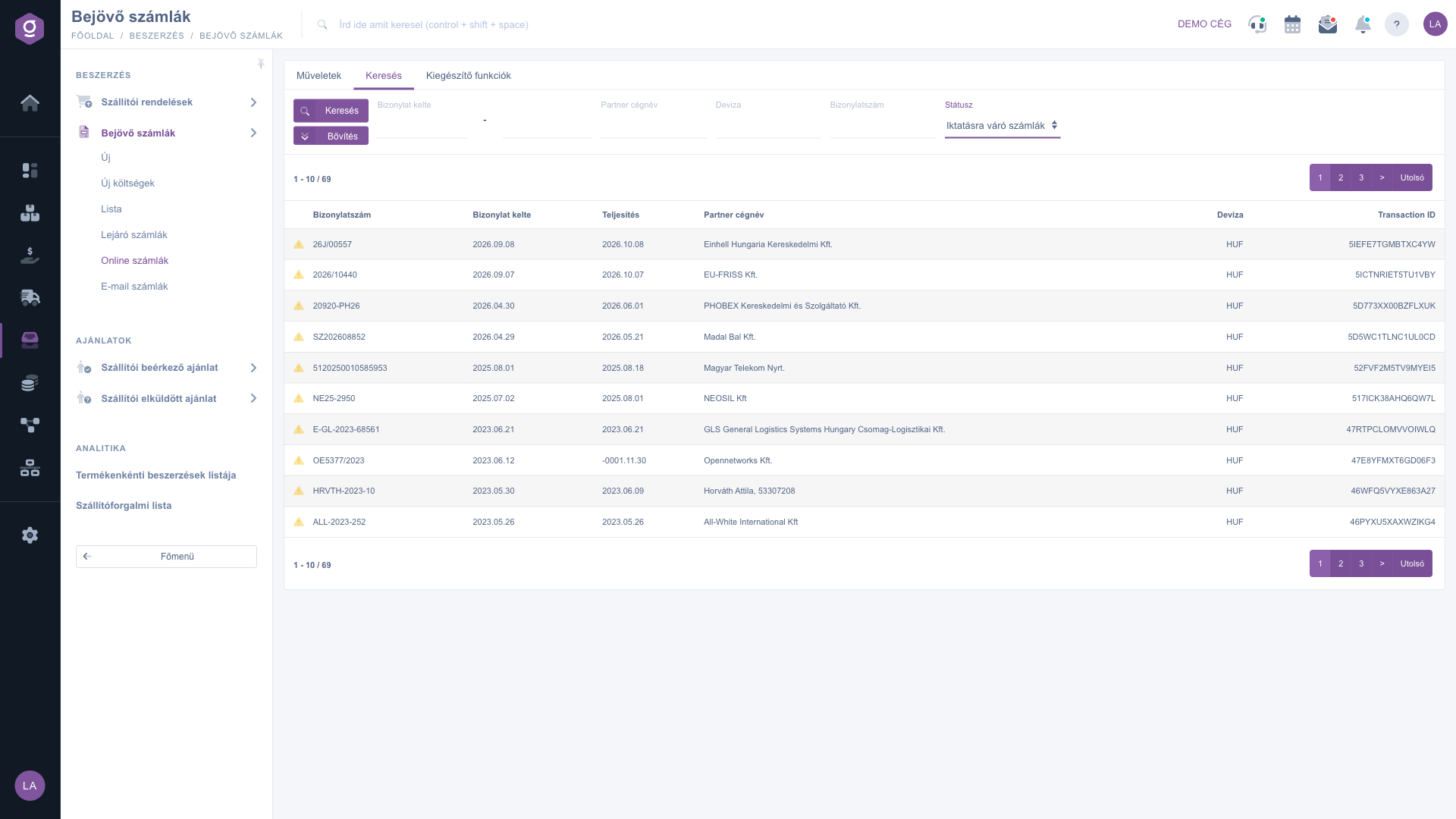
Online incoming invoices – Search tab (Keresés), invoices pending filing with a yellow triangle icon
2. Searching and filtering
On the Search tab you can filter by Document date (from and to), Partner company name, Currency, Document number and Status. The Status values are Filed invoices, Invoices pending filing and All invoices. For example, if you are looking for one supplier invoice, type the name into Partner company name, choose All invoices under Status and click Search: you immediately see whether the invoice is already filed. In the Filed invoices view a green check marks the invoices that already have an incoming invoice.
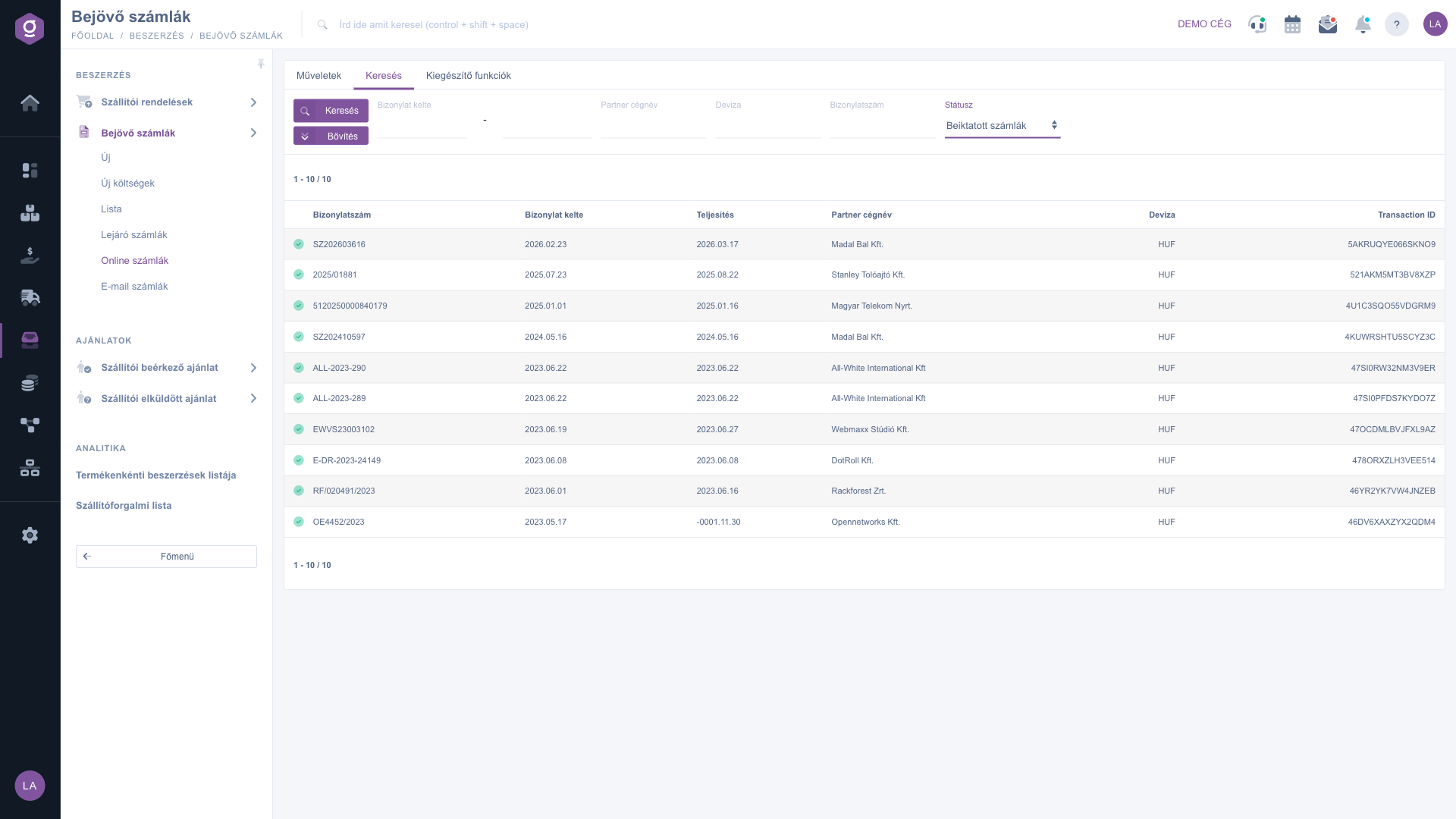
Search tab (Keresés) – Filed invoices with a green check icon
3. Selecting an invoice and Filing
Click the row of the invoice to be filed, then click Filing on the Operations tab. If no row is selected, the system shows a Warning window asking you to choose an item from the list, which you close with OK. Besides Filing and Simple registration, the Operations tab also has the Send email button.
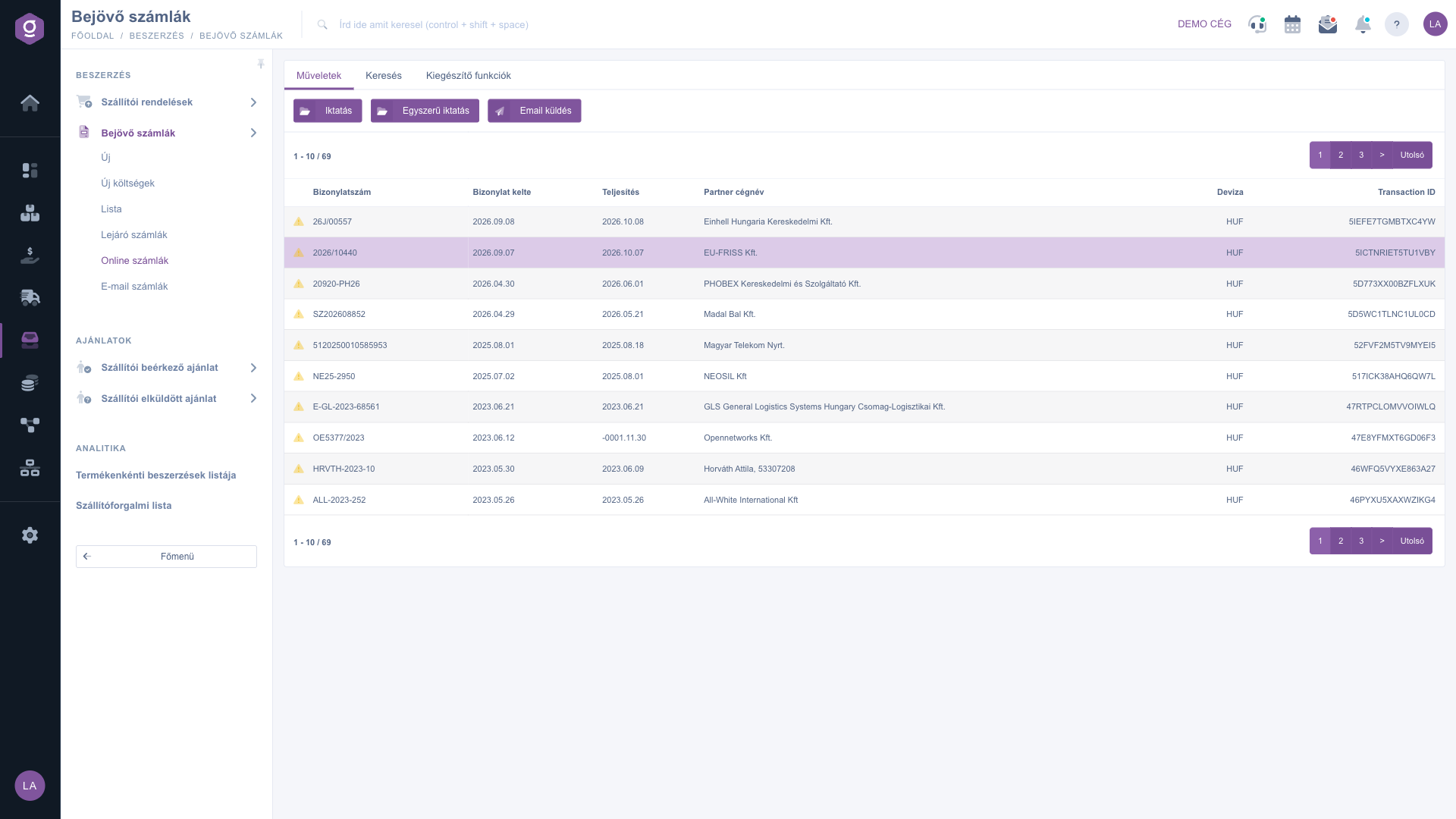
Operations tab (Műveletek) – Filing, Simple registration and Send email buttons with a selected row
The Filing button can do two things:
- If the selected invoice is not filed yet, a prefilled, new incoming invoice sheet opens (in a new browser tab, depending on your settings). The document number, dates, currency, partner and items are filled in from the NAV data.
- If the invoice is already filed, the system does not create a second one but takes you to the existing incoming invoice.
4. Checking the prefilled sheet
The sheet header reads New incoming invoice and its status is Draft. Warnings may appear at the top of the sheet: if the supplier is not in the partner master data, or the part numbers of the items are not in the product master data, you should sort these out before saving (create the partner, assign the product). Example: the invoice 2026/10440 of EU-FRISS Kft. produced a sheet with 10 items and warnings about the partner and the product master data. Check the header data and the items, correct anything that differs, then click Save. Until you save, nothing is stored in the system.
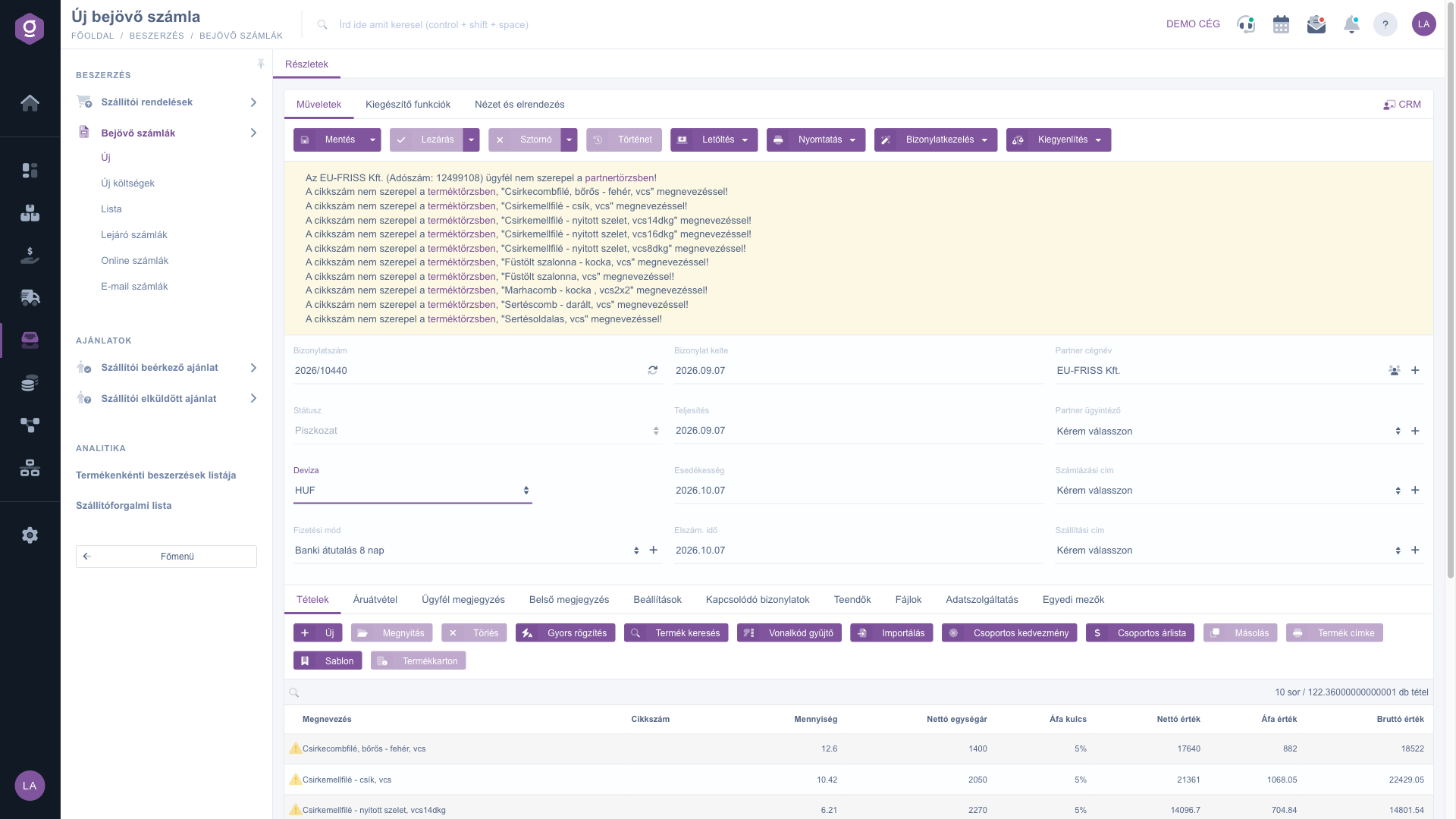
The prefilled New incoming invoice sheet (Új bejövő számla) opened after Filing, with warnings
5. Simple registration
Simple registration carries the same invoice over not item by item but with one combined line per VAT rate: every line becomes the Universal service item (part number USERVICE01). Example: if the invoice shows both 5% and 27% VAT, you get two lines. It is useful when you do not need detailed item records and the summarized value is enough.
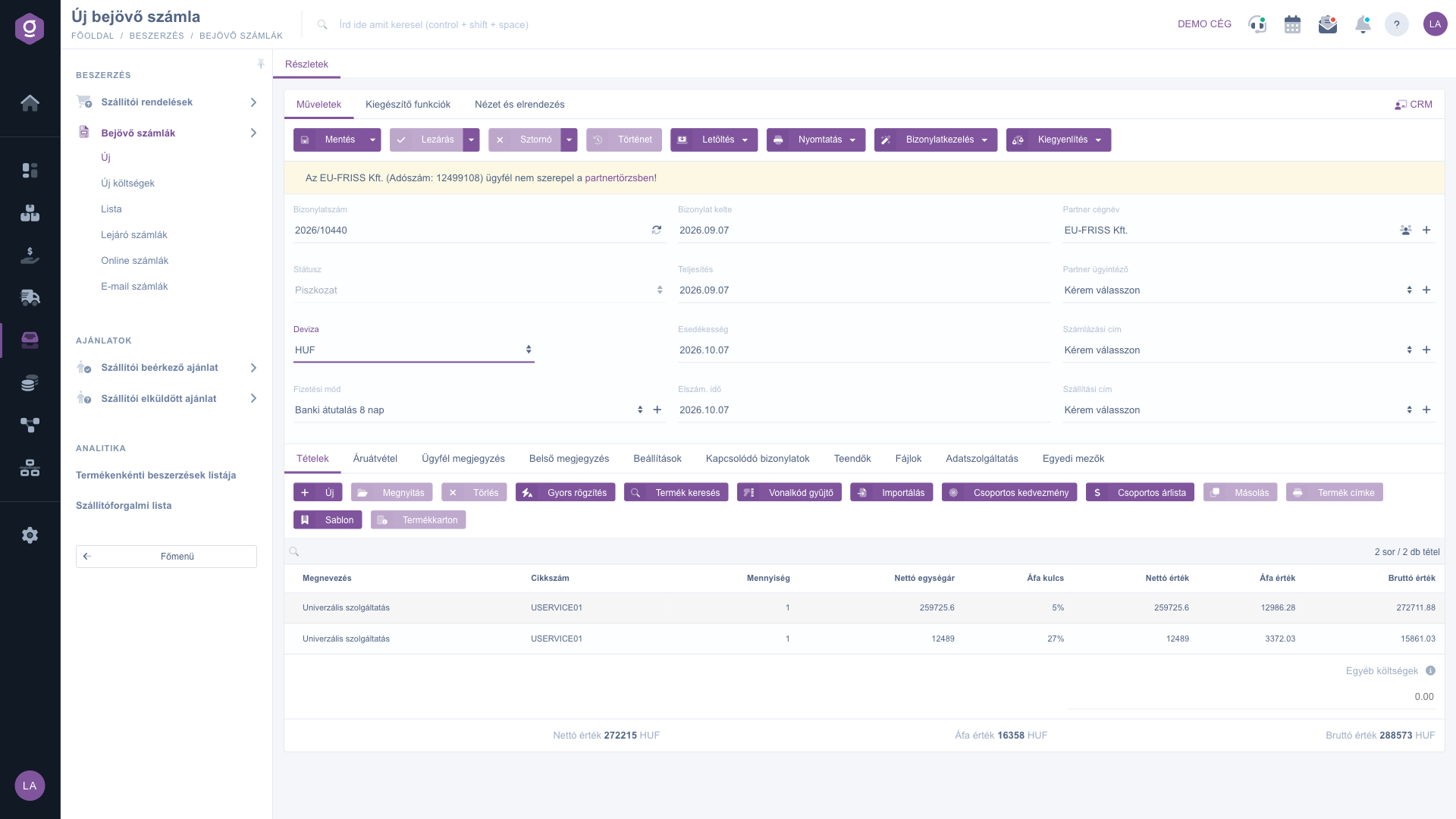
After Simple registration (Egyszerű iktatás): one Universal service line per VAT rate
6. After saving
The saved invoice is a Draft incoming invoice. From then on the list row shows a green check, and the Filing button leads to the existing invoice. Closing, cancelling and settling the invoice is described in the Invoice sheet guide. On the Additional functions tab you find Sent items, New email (external or internal mailer), New task, Partner card and CRM.
Tip
Before filing, keep the Status on the default Invoices pending filing and work through the list from top to bottom. If you are unsure whether you already recorded an invoice, search for the Document number in the All invoices view: the green check shows it immediately.
If you receive the invoice by email instead of through NAV, use the
Email invoices page. You can follow the due dates of recorded but not yet settled invoices on the
Expiring incoming invoices page. The shared handling elements of the lists are presented in the
Invoice list guide.