1. Viewing the list and the actions available for a document
Clicking the Main menu / Transport / Delivery note / List menu item shows every delivery note created so far. Above the table, the Actions tab gives you the following buttons for the selected document:
- New: create a new delivery note on an empty form. From the arrow next to the button, the New based on PDF option lets you create the delivery note from an uploaded PDF document, so you do not have to type everything in by hand.
- Open: open the detailed view of the selected document to check or edit its items and header data.
- Close: close the document — available only for documents in Draft status. With the arrow next to the button you can combine closing with printing (Close and print) or downloading (Close and download), so the paper or file that goes with the goods is immediately at hand.
- Delete: delete the document, or use the Delete and copy option to delete it and create a copy in one go — handy if you recorded the document with wrong data but want to create it again. You can delete documents in Draft, Closed and Used status.
- Cloning: create a new document based on the data of the selected one — for regular deliveries to the same partner it is faster than entering everything from scratch with the New button.
- History: view the other documents related to this one (for example the predecessor, or the invoice or warehouse issue created from the delivery note).
- Used: mark the closed delivery note with the Used status — use it when the delivery note has already been used (for example you have settled it) and you do not want it to keep appearing as an open delivery note. Available only for documents in Closed status.
- Send email: send the selected document by email — available only for documents in Closed status (or beyond).
- Download: export the list or the selected document. In the List operation block you can download the whole list (XLSX list, XLSX item list), and in the Document operation block the data of the selected document (XLSX items, XLSX serial number list, PDF, PDF preview, Download attachments). The final PDF can only be created for a closed document, while the PDF preview also works for a draft.
- Print: print the selected document — with the Document option you print the delivery note itself, with the Product label option the product labels of its items.
- Issue for fulfillment: hand over the closed delivery note. With the Transfer between Logzi systems option you can send the delivery note directly to your partner's Logzi system (if your partner also uses Logzi), and with the Fulfillment handover option you can pass it on to the fulfillment provider who carries out the order.
- Document management: create a new document from the selected delivery note, taking over its items: Invoicing (invoice), Proforma invoice, Advance invoice, Warehouse issue or Worksheets. The Cloning option creates a copy in the same way as above. These options are available only for documents in Closed status (or beyond).
At the right end of the tab row, the Analytics link takes you to the statistics page, and with the clipboard icon you can copy the contents of the table to the clipboard, for example to paste it into a spreadsheet.
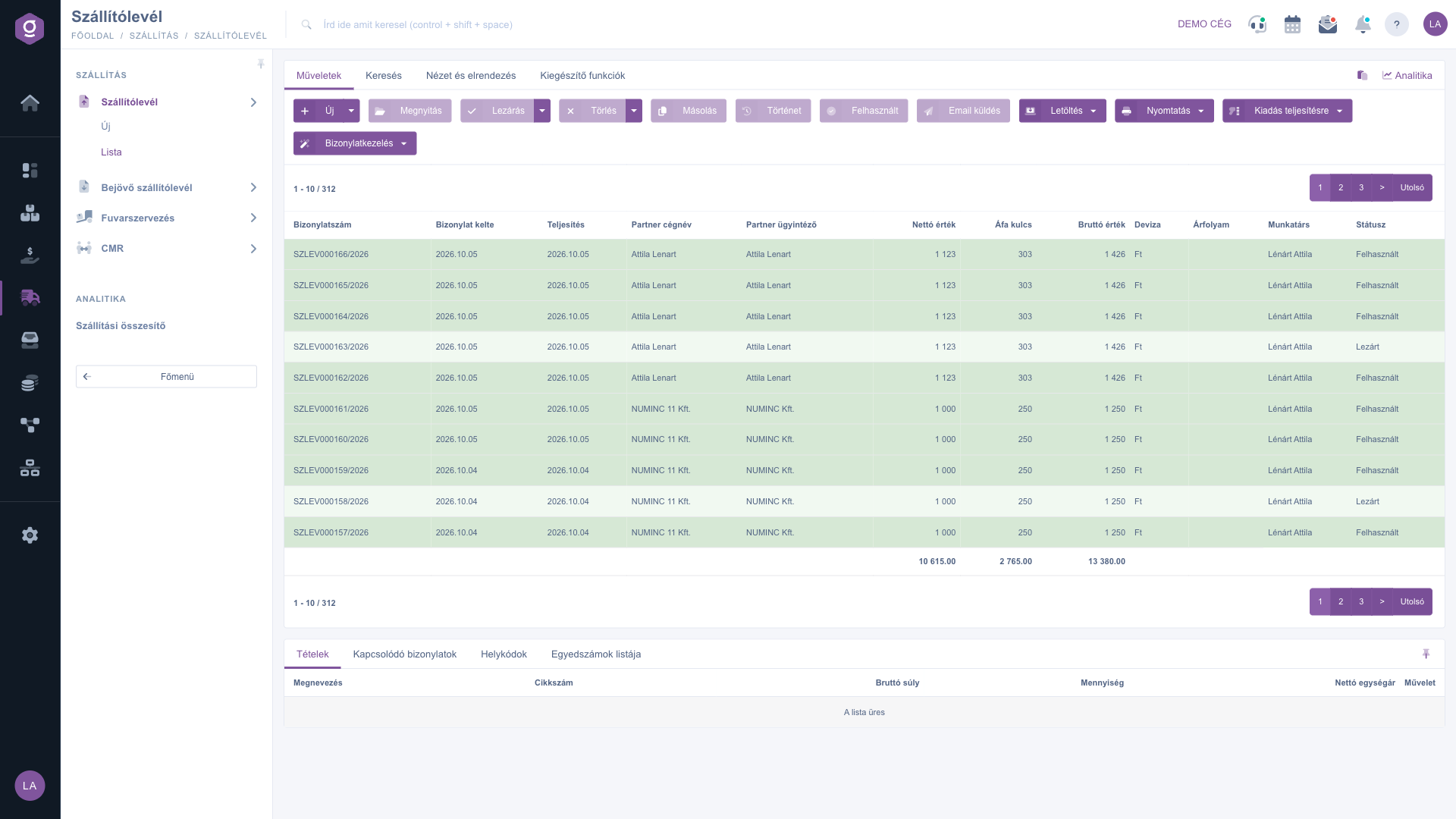
Delivery note list – Actions tab
Searching among documents
Click the Search tab above the table to show the filtering options. The most frequently used fields are visible right away: Partner company name, Document number, Currency and Status (you can select several statuses at once). Clicking the "Expand" button opens further, more detailed filters: Document date and Performance date (by specifying a period), Employee, Item number, Project, Job number, Department number and Serial number. Use the Search button to filter by the conditions you set; you can also save frequently used filter settings and delete them later, so you do not have to enter them again every time.
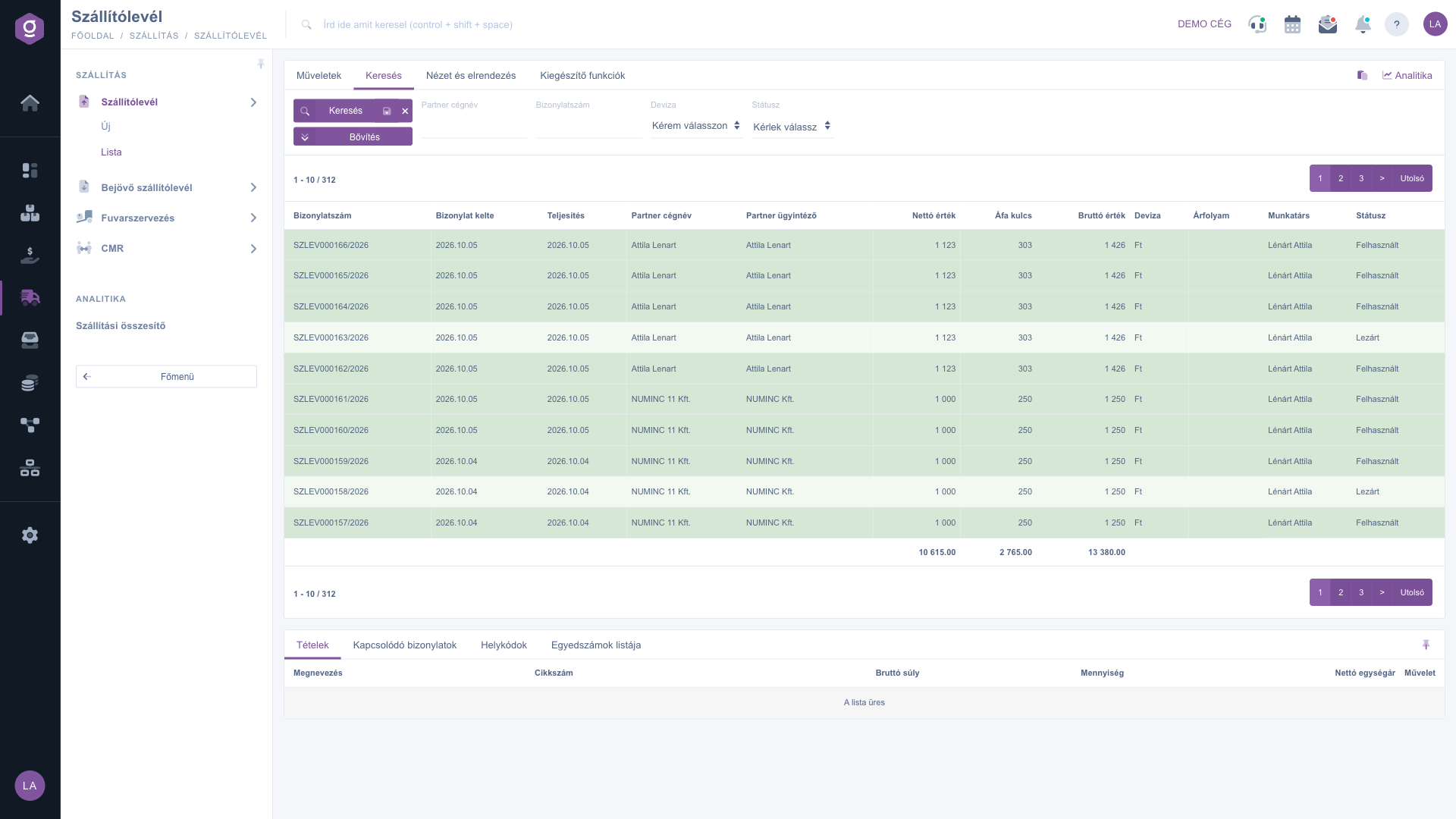
Delivery note list – Search tab
Customizing the view
On the View and layout tab you can set how the list is displayed for you:
- Columns: choose which fields are shown in the table and in what order.
- Rows: set how many documents are shown on one page.
- Sorting: choose by which column and in which direction the list is sorted by default.
- Preview window: turn the preview panel below the list on or off, or pin it (see below).
- Interface and behavior: other display-related settings of the list interface.
These settings are saved personally, tied to your user, so they are still there the next time you sign in.
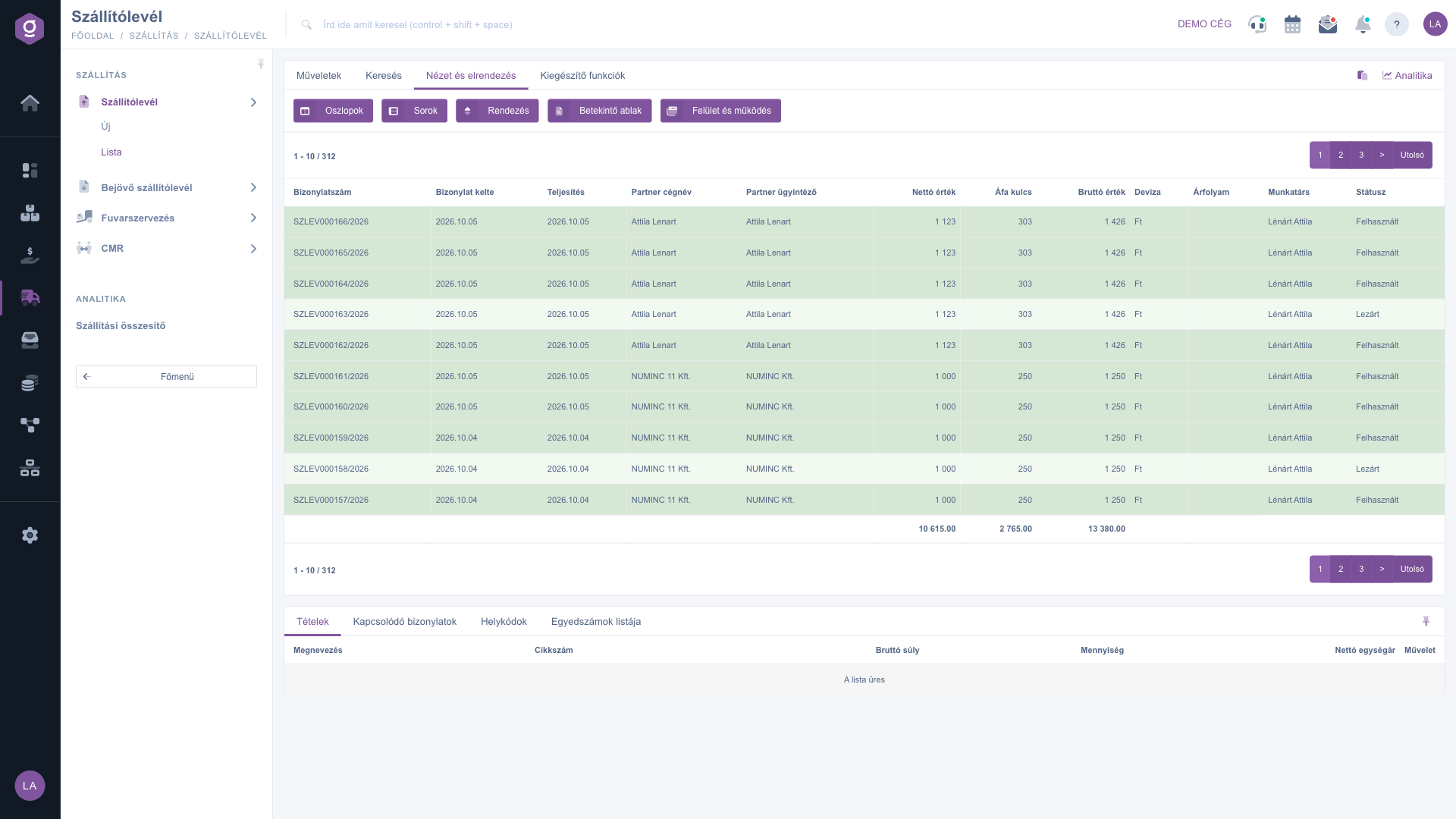
Delivery note list – View and layout tab
The preview window
In the panel below the list you can quickly check the details of a selected document without opening the document itself. The panel contains several tabs:
- Items: the products, quantities and prices on the document.
- Related documents: other documents linked to this one (for example the predecessor, or the invoice created from the delivery note).
- Location codes: the warehouse location code, warehouse and pallet information of the items.
- List of serial numbers: a breakdown by the unique identifiers (serial number, expiry date) recorded for the items.
With the icon in the top right corner the panel can be pinned (set to a fixed size), and its size can be adjusted by dragging the divider line at the top of the panel.
Additional functions
On the Additional functions tab you find extra options for the selected document that help your daily work:
- Sent items: view the emails previously sent for the document.
- New email: write a new email related to the document, either with the External mail client or with the Internal mail client built into the system.
- New task: create a task related to the document.
- Partner card: open the detailed record of the partner on the document.
- CRM: view the CRM notes and records of the partner.
Right-clicking a document row gives you the most common quick actions (open, close, delete, clone, history, print, attached files, partner card, CRM) in a context menu, the same as on the Actions tab; from this menu you can also create a new parcel label for the document (New parcel label) or check the labels already recorded for it (Parcel labels).
Tip
Do not re-enter the items if you also have to invoice the delivered goods: select the closed delivery note, then use Document management > Invoicing and the system creates the invoice with the items taken over. And if you need the document file or the paper for the goods right after closing, choose Close and download or Close and print from the arrow next to the Close button — then you do not need a separate step to download or print.
The counterpart of the outgoing delivery note is the incoming delivery note: if you are looking for details on recording and managing the delivery notes that accompany incoming goods, see the
Incoming delivery note list guide. The steps of creating a delivery note are described in the
Delivery note document guide, and if you also want to organize the shipping, you will find help in the
Transport organization list guide.