Detailed product list

Learn about the Detailed list: the product-group view with selectable columns and wider download options, and find out when to choose it instead of the plain List.

Function overview

The Detailed list shows your products at product group level: one row is one product together with all of its variants (for example a T-shirt appears in one row, not once for every size and colour). You choose the columns of the list yourself, so in a single table you can see the prices, stock, webshop status, manufacturer, category or even the thumbnail of a product.

  • Actions tab: the same product actions as in the List, plus a wider choice of Download options (XLSX, identifiers, translations, prices, full export).
  • Search tab: identical to the search of the List: Name, Item number, Type, Main category, Web category, Active and the further filters under Expand.
  • View and layout tab: three buttons: Columns (Oszlopok; which columns are shown), Rows (Sorok; how many rows per page) and Sorting.
  • When to choose it: when you want an overview product by product, or you need more columns for checking (prices, stock, missing data) and for exporting. If you are looking for one specific item number, use the List instead.

The Type column shows the type of the product: Simple product, Variant product, Recipe-based product, Service, Package product or Virtual product - Entry ticket. A product can also be active or inactive: an inactive product is not deleted, it is only taken out of the active catalogue, and earlier documents are not affected.

The screenshots in this article were taken in the Hungarian interface. In other languages the labels shown in the images appear in your language; the Hungarian names are given in parentheses where it helps. The list at item-number level is described in Product list; how to fill in the data of a product is described in Product sheet.

Step by step

1. Opening the list

Click Main menu / Master data / Products / Detailed list. The module is only visible if it is assigned to your user. If you cannot see it, ask the system administrator to check the module assignment.

2. List or Detailed list?

Both views show the same products, but from a different angle:

  • What does a row mean? In the List one row is one item number (item); in the Detailed list one row is a product group, that is, one product with all of its variants.
  • Columns: in the List they are fixed (Item number, Name, KN/TESZOR, Gross weight); in the Detailed list you choose them with the Columns button (by default: Name, Manufacturer, Category, Customs tariff/service code and Type).
  • Number of rows: the List shows 100 rows per page by default, the Detailed list 25, because one row carries more data.
  • Download: in the List there is a single “XLSX list” item; in the Detailed list you can also download identifiers, translations, prices and a full export next to the plain XLSX.
  • Prices, Stock history, Serial numbers: in the List they refer to the selected item number, in the Detailed list to the selected product group.

In short: if you look for one specific item number, or you need a quick jump to Prices or Serial numbers, use the List. If you want to review products one by one, compare them, or save a lot of data, use the Detailed list.

3. The Actions tab

The list opens on the Actions tab. Click a row to select it; this activates the buttons that work on a product (while no row is selected they are greyed out).
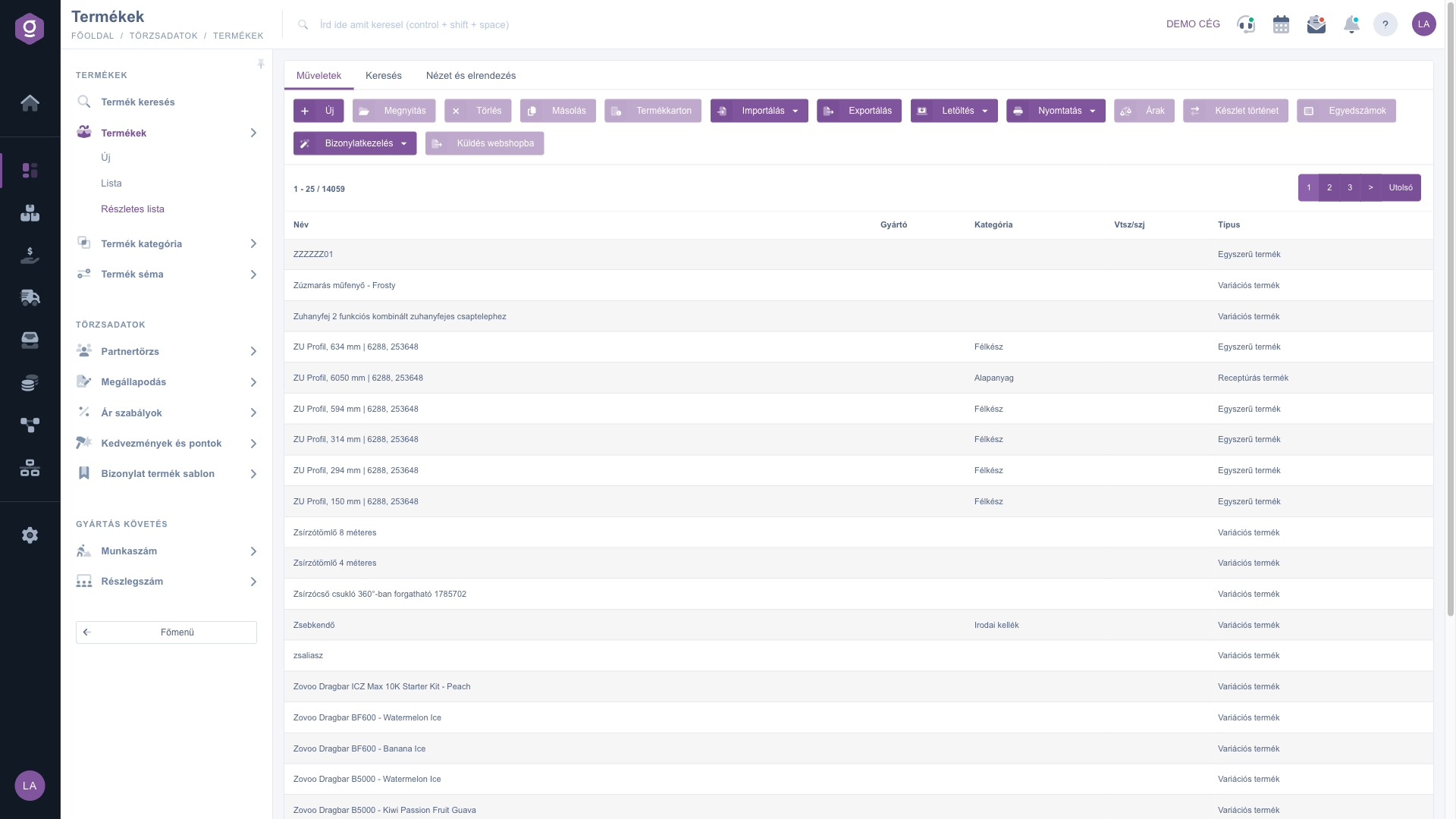
Detailed product list – the buttons of the Actions tab

The buttons and when to choose each of them:

  • New, Open, Delete, Cloning: they work the same way as in the List. New opens an empty sheet, Open opens the sheet of the selected product, Cloning opens a new sheet filled with the data of the product, and Delete deletes the selected product(s) after confirmation. If the deletion is not possible, the system tells you the reason in a message.
  • Product card: if the product has several variants, it first lists them in a window, and you choose the item number whose card you want to see; with a single item number it opens the card directly. Use it when you want the summarised data or movements of one variant.
  • Import: a drop-down menu. The XLSX item opens a window where you can upload an XLSX file containing products, and a progress indicator shows the processing. The Universal item opens the general import wizard in a new tab. Choose XLSX when you upload a product spreadsheet, Universal when you want to work with the general wizard.
  • Export: opens the export wizard in a new tab. Choose it when you want to export a data set that you put together in the wizard.
  • Download: a drop-down menu for saving data to an XLSX file. XLSX gives a spreadsheet in importable format (with a help sheet), XLSX identifiers the alternative item numbers and barcodes of the products, XLSX translations the names, descriptions and meta data of the product groups in other languages, XLSX prices the price list, and XLSX teljes (the Hungarian name of the full export) the detailed data of the products, including parameters and web categories. Always choose the one that fits your task.
  • Print: a drop-down menu whose Product label item prints a label for the selected product.
  • Prices: opens the prices of the selected product group. Choose it when you want to see or correct the price rules of a product. See also Itemized price list.
  • Stock history: shows the stock movements of the product. Serial numbers: lists the serial numbers (serial or lot numbers) of the product. Use them when you want to find out what happened to the stock, or when you are looking for a specific piece.
  • Document management: a drop-down menu for starting a new Invoice or Customer order document from the selected product, or for Cloning. Use it when you want to carry the product over to a new document right away.
  • Send to webshop: creates a synchronisation event, so the selected product is sent to the webshop shortly. Use it when you do not want to wait for the scheduled synchronisation after a change.

4. Search

On the Search tab you can filter by Name, Item number, Type, Main category, Web category (several values can be chosen) and Active. The Expand button opens further filters (manufacturer, default supplier, product parameters, stock management, webshop sync, whether a price is set, serial number and so on). Click Search to apply the conditions; the save icon next to it saves the search, and the x icon deletes the saved search and loads the full list.
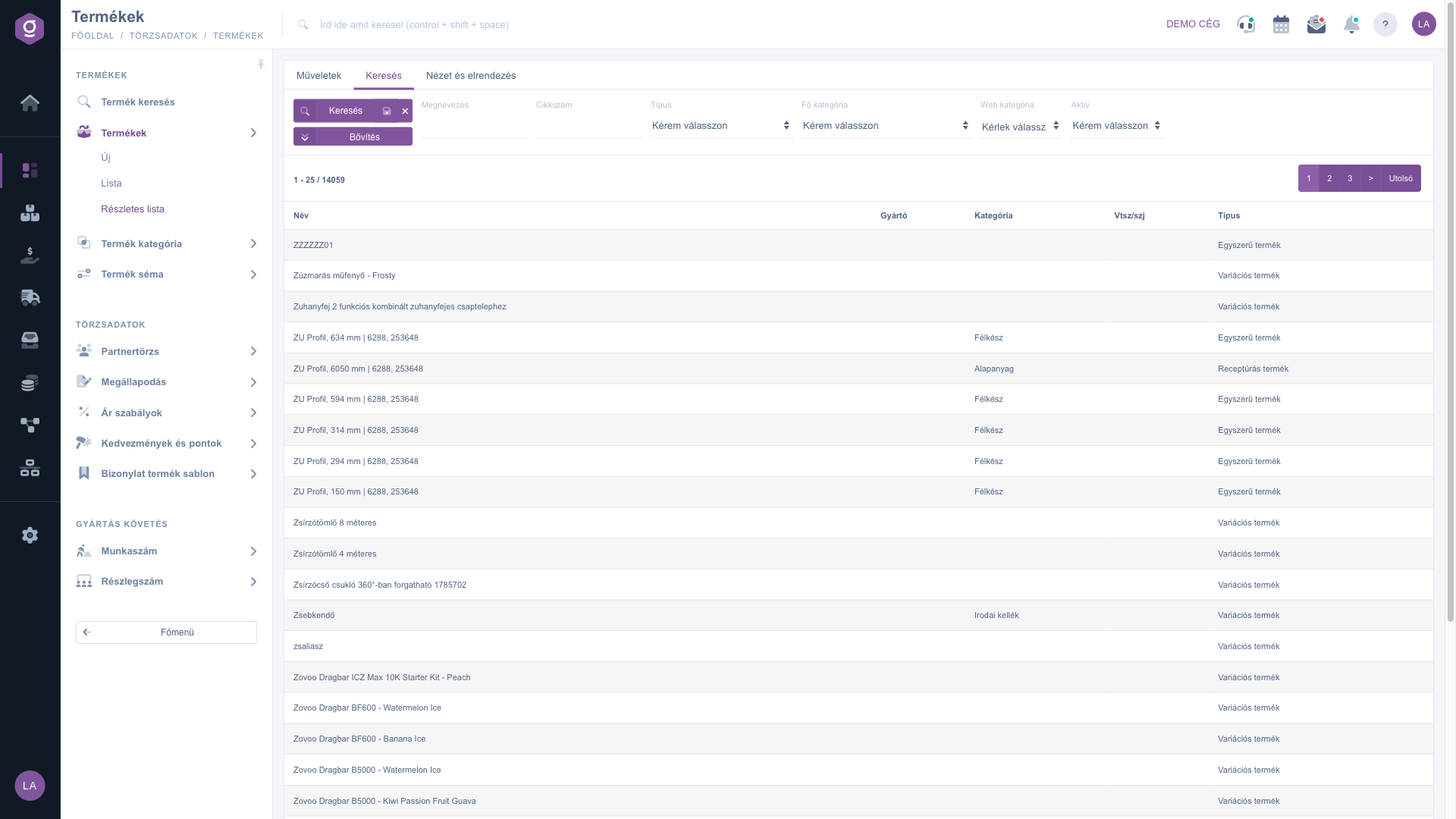
Detailed product list – the Search tab

5. Customising the columns and the view

The View and layout tab has three buttons. Columns (Oszlopok) opens a window where you tick the columns to show in the Active column and, with the move icon, change their order. The search field at the top helps you find a column quickly in the long list. In the window you can use Save, Default (restore), Select all and Deselect all. Rows (Sorok) sets how many rows are shown on a page. Sorting lets you choose by which column and in which direction the list is sorted. These settings are saved for your user, so they are still there the next time you sign in. You can also sort directly by clicking the column headers. The columns you can choose are listed in the table of the next section.
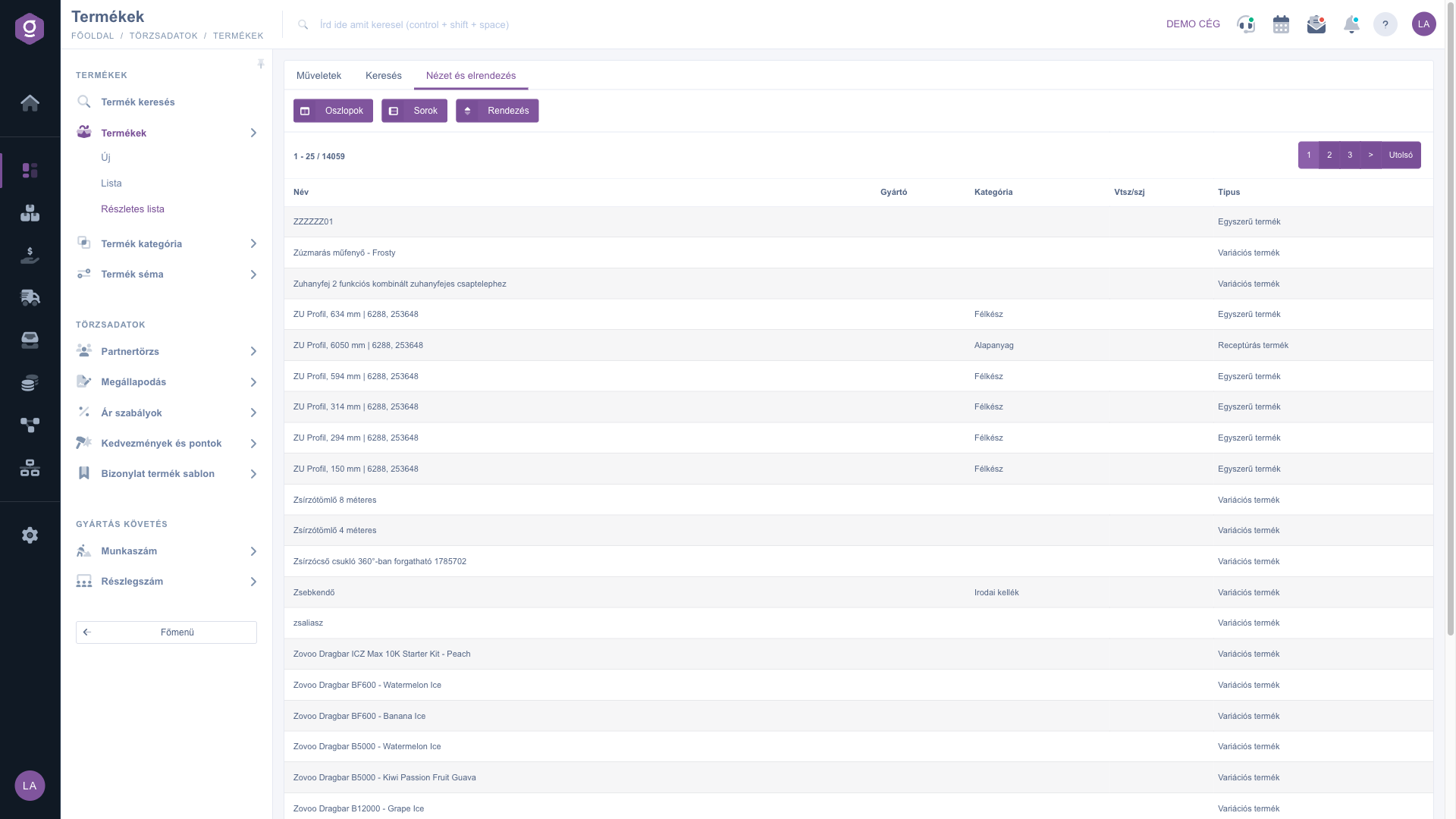
Detailed product list – the View and layout tab

Tip


Build your own price-check view: in the Columns window switch on the Eladási ár (selling price), Akciós eladási ár (promotional selling price), Akció érvényesség (promotion validity) and Elérhető készlet (available stock) columns, then on the Search tab, under Expand, filter by Promotional price set. At a glance you see which products are on promotion, until when the promotion is valid and how much of them is in stock. With Download / XLSX you can save the whole view to a spreadsheet.


Field descriptions

The fields of the Search tab are the same as the search fields of the List (Name, Item number, Type, Main category, Web category, Active and the filters under Expand); they are described in the Product list article. The column names in the column selector come from the system and appear in Hungarian, therefore the table gives the Hungarian name first and then its meaning. The columns you can choose in the Columns window:

Field / ColumnRequiredDescription
Azonosító, Csoport azonosítóThe internal identifier of the product and of the product group.
MegnevezésThe name of the product (by default it is shown as the “Name” column).
KN/TESZORThe customs tariff (KN) or TESZOR number of the product.
Rövid leírásThe short description entered on the product sheet.
Termék típusThe type of the product: simple, variant, recipe-based, service, package or virtual product.
KategóriaThe name of the main category of the product in the system.
Gyártó cégnév, Gyártó adószámThe name and tax number of the manufacturer partner entered for the product.
Létrehozó munkatársThe name of the colleague who created the product.
Eladási ár, Eladási ár (Bruttó), Eladási ÁFA kulcsThe selling price of the product net and gross, and the selling VAT rate.
Akciós eladási ár, Akciós eladási ár (Bruttó), Akció érvényességThe promotional price net and gross, and the date when the promotion expires.
Beszerzési ár, Beszerzési ÁFA kulcsThe purchase price of the product and its VAT rate.
Utolsó beszerzési ár, Utolsó beszerzési ÁFA kulcsThe price and VAT rate of the most recent actual purchase.
Elérhető készlet, Fizikai készlet, Foglalt készletThe stock data of the product: the available, the physically present and the reserved quantity.
Minimum készletThe minimum stock level entered for the product.
CikkszámokThe item numbers of the product group (several in the case of variants).
Vonalkódok, Vonalkódok partnereThe barcodes entered for the product and the partner of the barcode.
Egyedszám kötelesThe serial number tracking setting (serial number, lot number).
Készletet kezelA green tick shows that the system tracks the stock of the product.
Webshop szinkronban szerepelA green tick shows that the product takes part in the webshop synchronisation.
Súly (nettó), Súly (bruttó)The net and the gross weight of the product.
HelykódThe barcode of the default storage location of the product.
TermékképThe thumbnail of the product; when you hover over it, a larger preview appears.
Meta title, Meta kulcsszó, Meta leírásThe SEO data entered for the webshop.
AktívA green tick marks an active product, a question mark an inactive one.
Létrehozás dátum, Módosítás dátumThe time when the product was created and when it was last modified.

Frequently asked questions

The List shows products at item-number level with fixed columns; the Detailed list shows them at product-group level, that is, one product in one row with all of its variants, and you choose the columns yourself (price, stock, webshop sync and so on). For finding a specific item number and for the quick jump to Prices, Stock history and Serial numbers the List is better; for a product-by-product overview and for saving a lot of data the Detailed list is the better choice. More details: Product list.

Because the Detailed list works at product-group level: the variants (for example sizes and colours) are on the Product variations tab of the product sheet, and the Cikkszámok column lists them. If you want to see every item number in a separate row, use the List. You can read about managing variants in the Product sheet article.

On the View and layout tab click Columns (Oszlopok), tick the columns you want in the Active column (with the move icon you can also change the order), then click Save. The Default button restores the original set of columns. The setting is saved for your user.

By default only five columns are shown: Name, Manufacturer, Category, Customs tariff/service code and Type. Prices, stock, barcodes, thumbnails and the other data have to be switched on in the Columns window.

XLSX gives a spreadsheet in importable format, XLSX identifiers the identifiers (for example barcodes), XLSX translations the data in other languages, XLSX prices the prices, and XLSX teljes the full set of product data. Choose only what you need: a smaller file is faster to produce and easier to handle.

The Open, Delete, Cloning, Product card, Prices, Stock history, Serial numbers and Send to webshop buttons only work on a selected row; without a selection a warning asking you to select an item from the list appears. If the deletion is not possible, the system tells you the reason in a message. In that case, or if you simply want to retire the product, remove the Active tick on its sheet.

On the Search tab check whether the Active, Type or one of the conditions under Expand filters the product out, and whether a saved search is active (you can delete it with the x icon). If the result is not on the current page, jump to the first page (the empty-list message also offers a link for this). If the list is really empty, create a product with the New button.

Select the product and click Send to webshop. The system creates a synchronisation event and the product is synchronised shortly; a confirmation message appears when the event has been created.

The Products module is only shown in the menu if it is assigned to your user. If you cannot see it, ask the system administrator to check the module assignment.

Need personalized help?

Don't want to spend hours searching for a solution? Choose the most efficient way: book a personalized, 45-minute online training session dedicated entirely to you. Whether it's a walkthrough of the basics or a detailed setup of a specific module, our expert colleague will guide you through the whole process, step by step.

Don't waste your time - ask for help!
Our goal is to get you using our system as quickly and efficiently as possible. Whether you're completely new to us or stuck on a specific setting, don't hesitate to ask for help!

Logzi warehouse management software

Get in touch with us

Interested in our software? Feel free to write to us!

Need help?

If you can't find the answer and need assistance

Create your account now,
pay later!

Try it free for 3 days, no risk, no obligation!