Product category list

Learn the product category list: how you see the category tree through the category paths, and how you search, open, delete, import and export categories.

Function overview

The Product category list (Hungarian: Termék kategória) shows the category tree of your products in a single table. Categories can be nested: every category can have a parent, so a multi-level tree is built (for example Our brands > Salus > Transitional shoe > Base material). The Category path column of the list shows the full path of every category starting from the top level.

The system uses categories in several places:

  • Classifying products: on the product sheet you can assign one or more categories to the product.
  • Filtering: the category tree on the left of Product search and the category filters of the product lists are built on them, if the matching display setting is turned on for the category.
  • Webshop: the category can appear on the category page and in the category menu of the webshop, with its own SEO data and web URL.
  • Product parameters: the product schema can be linked to categories, so a product receives the parameters to fill in based on its categories.

Categories have no document status (no draft or closed state): a category either exists or is deleted. A deleted category disappears from the list.

The editing of the category data is described in the article Product category sheet. You can read about searching by category in Product search, and about the parameters linked to categories in Product schema list.

Step by step

1. Viewing the list and the actions you can do with categories

Main menu / Master data / Product category / List. All the categories you have created are shown. Above the list there are three tabs: Actions, Search and View and layout. With the buttons on the Actions tab you work with the selected row (click the row in the table to select it):

  • New: creating a new category on an empty sheet (the same is available with the menu item Main menu / Master data / Product category / New).
  • Open: opening the sheet of the selected category.
  • Delete: deleting the selected category after confirmation. When deleting, the system does not check whether products or subcategories belong to the category, so check these before deleting.
  • Import: mass loading of categories with the import wizard.
  • Export: reading out the categories with the export wizard.
  • Download: the XLSX list item of the List operation menu saves the content of the list to an XLSX file.

Note: the screenshots show the Hungarian demo interface; the names in your own language are the ones written in bold in this guide.
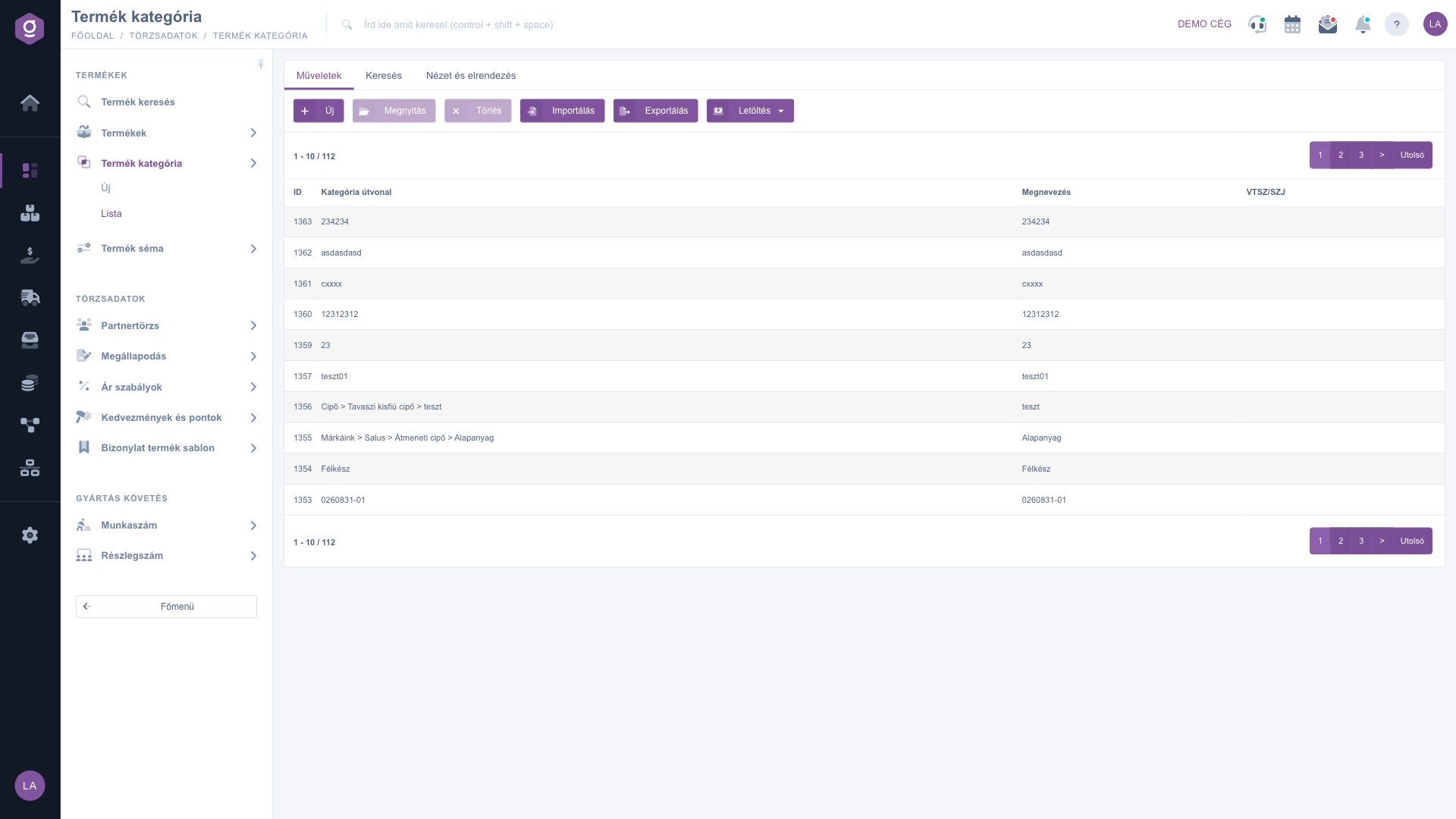
Product category list – Actions tab

2. Searching among the categories

On the Search tab you can filter with two conditions: in the Name field you can type a part of the category name, and in the Parent category field you can select a category, in which case the list shows the direct subcategories of the selected category (without the deeper levels). Click the Search button to filter by the conditions you set.
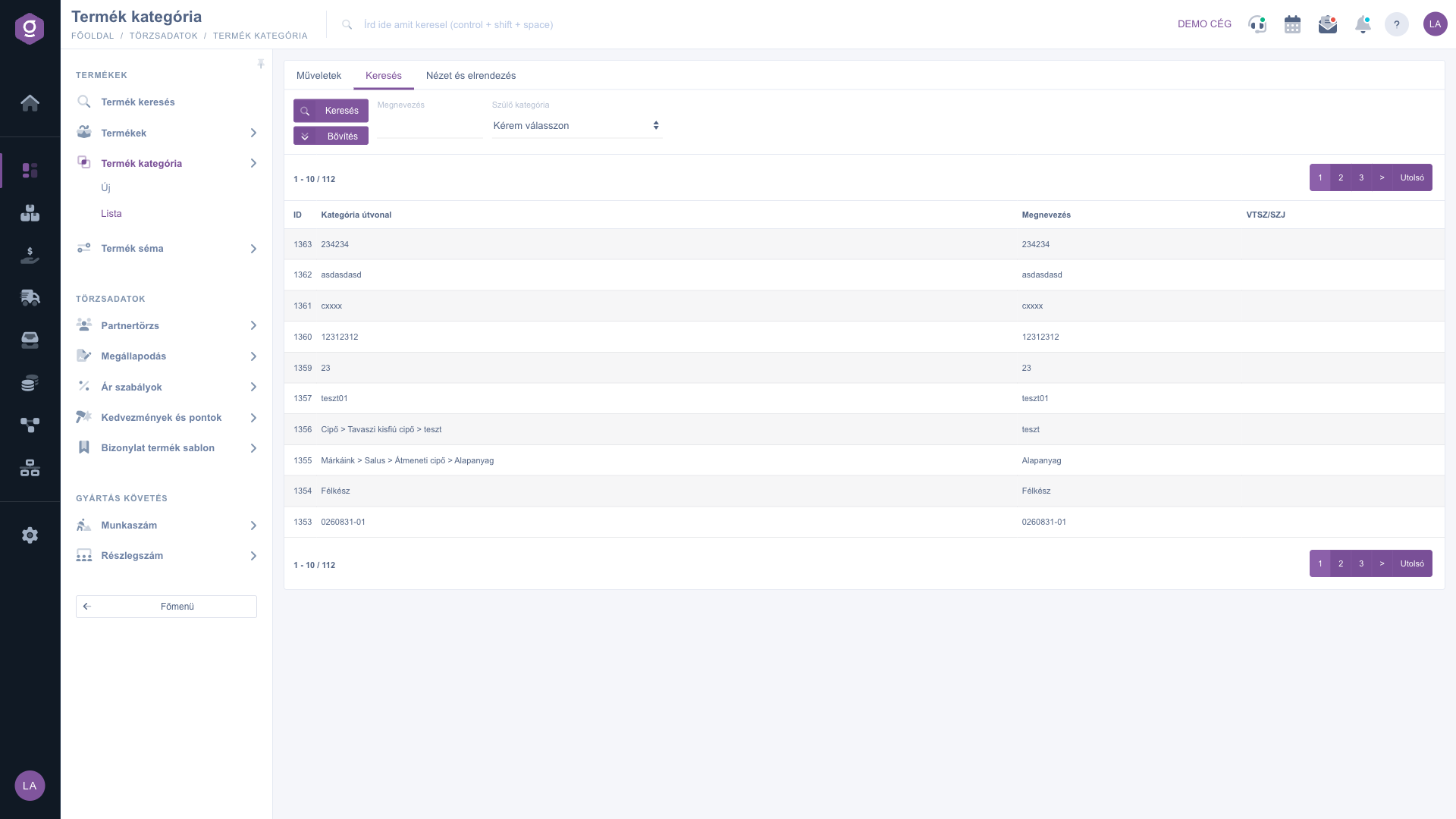
Product category list – Search tab

Customizing the view

The View and layout tab has three buttons:

  • Columns: opens a window where you can use the Active check boxes to choose which columns are shown, and the drag icon to reorder them. In the window you can use the Save, Default (reset), Select all and Deselect all buttons.
  • Rows: set how many rows are shown on one page.
  • Sorting: choose which column and in which direction the list is sorted.

These settings are saved for your user, so they are kept the next time you sign in. You can also sort the list directly by clicking the arrows next to the column names in the header.
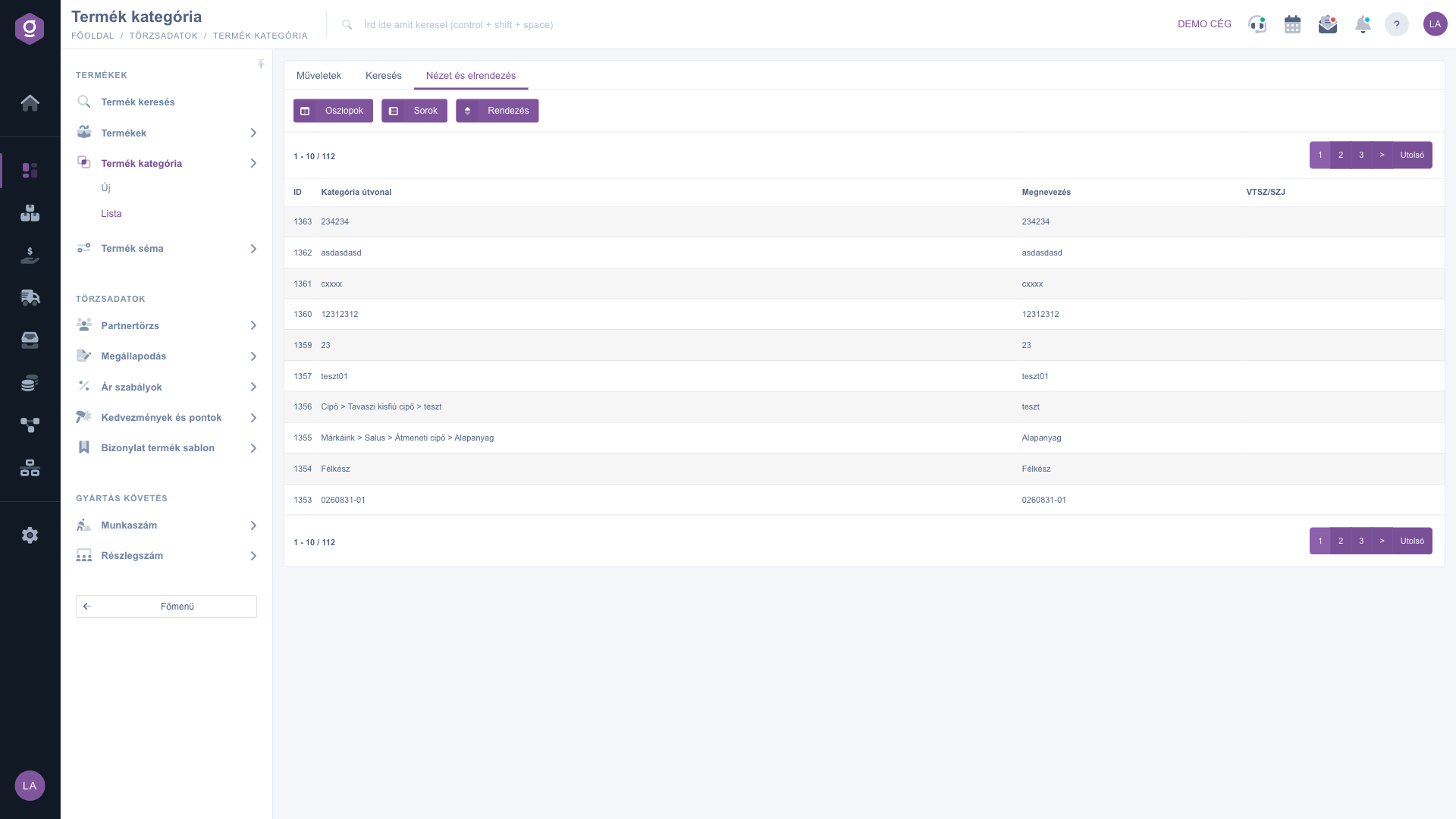
Product category list – View and layout tab

Tip


If you want to move the Transitional shoe category under Shoe, find it in the list with the Name field, open it, and on the Parent category tab select the Shoe category. After saving, the Category path column of the list already shows the path Shoe > Transitional shoe.


Field descriptions

The columns of the default table and their meaning:

Field / ColumnRequiredDescription
IDThe unique identifier of the category. It is assigned by the system and cannot be changed.
Category pathThe full path of the category from the top level, with the levels separated by >. For a top-level category it is the same as the name.
NameThe name of the category, on its own level.
VTSZ/SZJThe customs tariff (VTSZ) or service (SZJ) code given for the category.

The range of the displayed columns can be customized in the View and layout > Columns setting; the list above shows the default view.

Frequently asked questions

There is no restore in the interface: a deleted category disappears from the list and can no longer be selected. Deleting does not check whether products or subcategories belong to it, so if you are not sure, rename the category with the Open button or move it under another parent instead.

By default the list shows 10 rows per page; you reach the rest with the pager or the View and layout > Rows setting. If you use the Parent category filter, only the direct subcategories of the selected category appear, not the deeper levels. Clear the filter, or search with the Name field.

Select the category, click Open, and on the sheet you can make the changes on the Parent category, Settings and SEO tabs. You can find the description of the fields in the article Product category sheet.

With the Import button on the Actions tab, the import wizard helps you load categories in bulk. To save out an existing state, use the Export button or the Download > XLSX list item.

The menu item appears under Main menu / Master data if the module is assigned to your user. If you cannot see it, ask the system administrator to check the module assignment in your user settings.

Need personalized help?

Don't want to spend hours searching for a solution? Choose the most efficient way: book a personalized, 45-minute online training session dedicated entirely to you. Whether it's a walkthrough of the basics or a detailed setup of a specific module, our expert colleague will guide you through the whole process, step by step.

Don't waste your time - ask for help!
Our goal is to get you using our system as quickly and efficiently as possible. Whether you're completely new to us or stuck on a specific setting, don't hesitate to ask for help!

Logzi warehouse management software

Get in touch with us

Interested in our software? Feel free to write to us!

Need help?

If you can't find the answer and need assistance

Create your account now,
pay later!

Try it free for 3 days, no risk, no obligation!