Disassembly document

Learn how to create a disassembly document in Logzi: choosing the finished product, loading the ingredients, saving and closing.

Function overview

With the Disassembly document you take a finished product apart and return its ingredients to stock. This is the reverse of Assembly: when the document is closed, the stock of the finished product decreases and the stock of the ingredients increases. The document number is generated automatically, for example DSZR000005/2025.

  • Finished product and quantity: you choose which product and how many pieces to disassemble.
  • Automatic ingredients: the system fills in the items from the composition of the product (the Ingredients tab of the product record), multiplied by the quantity of the document.
  • Manual editing: you can freely edit the items while the document is in Draft status.
  • Automatic stock movement: on closing, a warehouse issue (finished product) and a warehouse receipt (ingredients) are created.

Possible statuses

  • Draft – editable, does not affect stock yet.
  • Closed – the stock movement has been made and the document cannot be modified.
  • Cancellation – a cancellation document.
  • Cancelled – the original, cancelled document.

Step by step

1. Starting a new document

Click Main menu / Stock management / Disassembly / New, or the New button on the Main menu / Stock management / Disassembly / List page. The New disassembly sheet opens; the Site field is pre-filled with the default site.
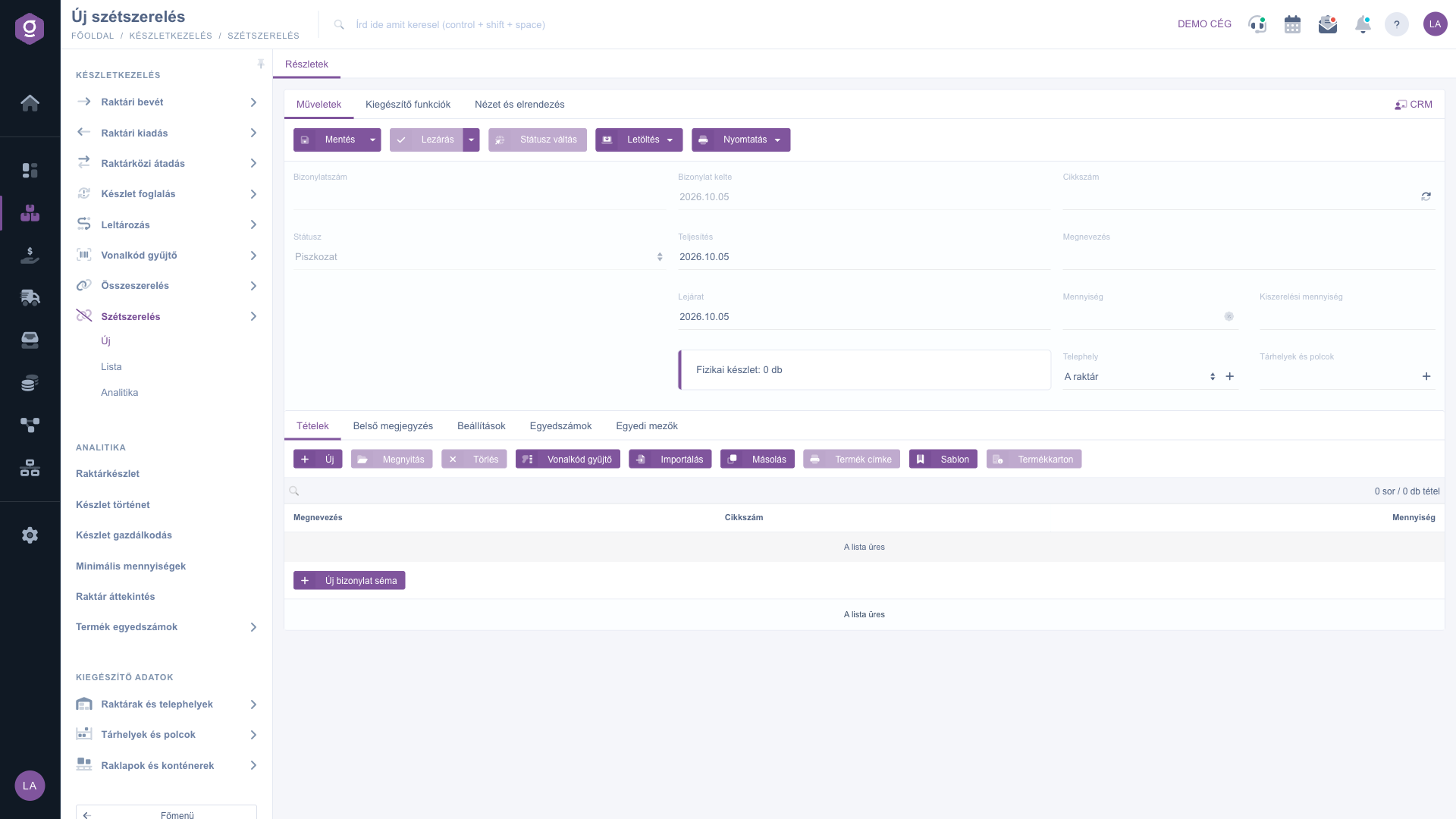
New disassembly sheet

2. Choosing the finished product

Fill in the Performance date and Expiration dates, then type the details of the finished product to disassemble into the Item number or Name field and select it from the results. Enter the Quantity (how many pieces you disassemble), the Packing quantity if needed, and check the Site. With Storage locations and shelves you can also specify the exact place of the stock. Next to the fields an info box shows the Physical stock of the product, so you can see immediately whether there are enough pieces to disassemble.

3. Loading the ingredients (items)

When you select the product, the Items tab is filled automatically with the ingredients of the product. The list comes from the Ingredients tab of the finished product record, and the system multiplies the quantities by the Quantity of the document: if a product consists of 2 screws and you disassemble 5 pieces, the item will be 10 pieces. The items are refreshed when you change the quantity, or you can reload them with the refresh button next to Item number. If the product has no composition, add the items manually. The buttons of the item bar:

  • New – adds a new item; use it when a part also returns to stock that is not in the composition.
  • Open – opens and edits the selected item.
  • Delete – removes the selected item.
  • Barcode collector – adds items by scanning barcodes, useful when you read in the parts you are holding.
  • Cloning – copies the selected item.
  • Product label – prints the label of the ingredient.
  • Product card – opens the product card of the selected item.

At least one item is required to save the document.
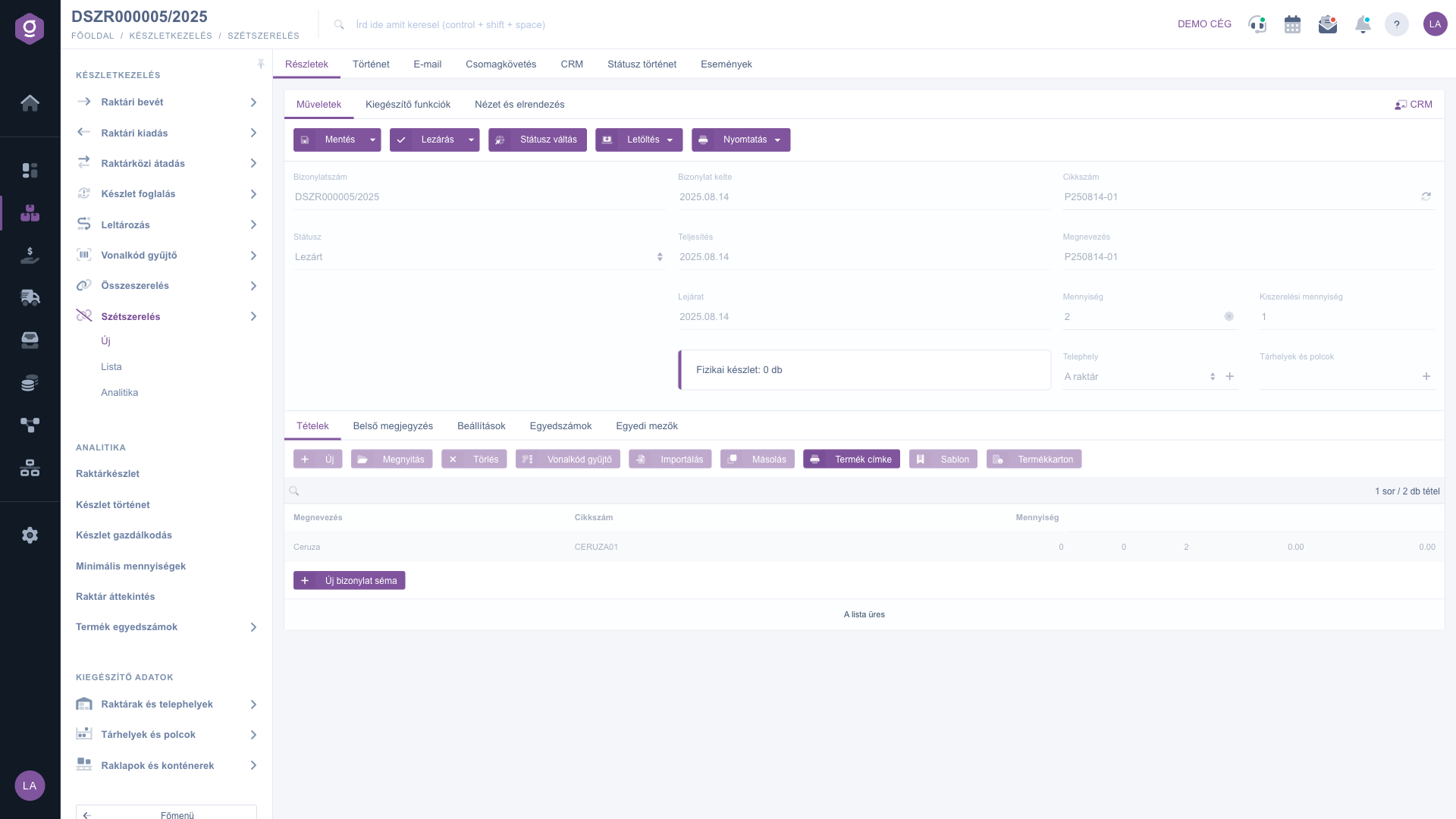
Saved disassembly document on the Items tab

4. Other tabs: Settings, Serial numbers

On the Settings tab you can enter the Billing address and the Employee. On the Serial numbers tab (Name, Item number, Quantity, Serial number, Expiration date) you record the data of products with serial numbers or expiry dates. The Internal comment tab is for a free-text note, and the Custom fields tab contains the custom fields defined by your company.
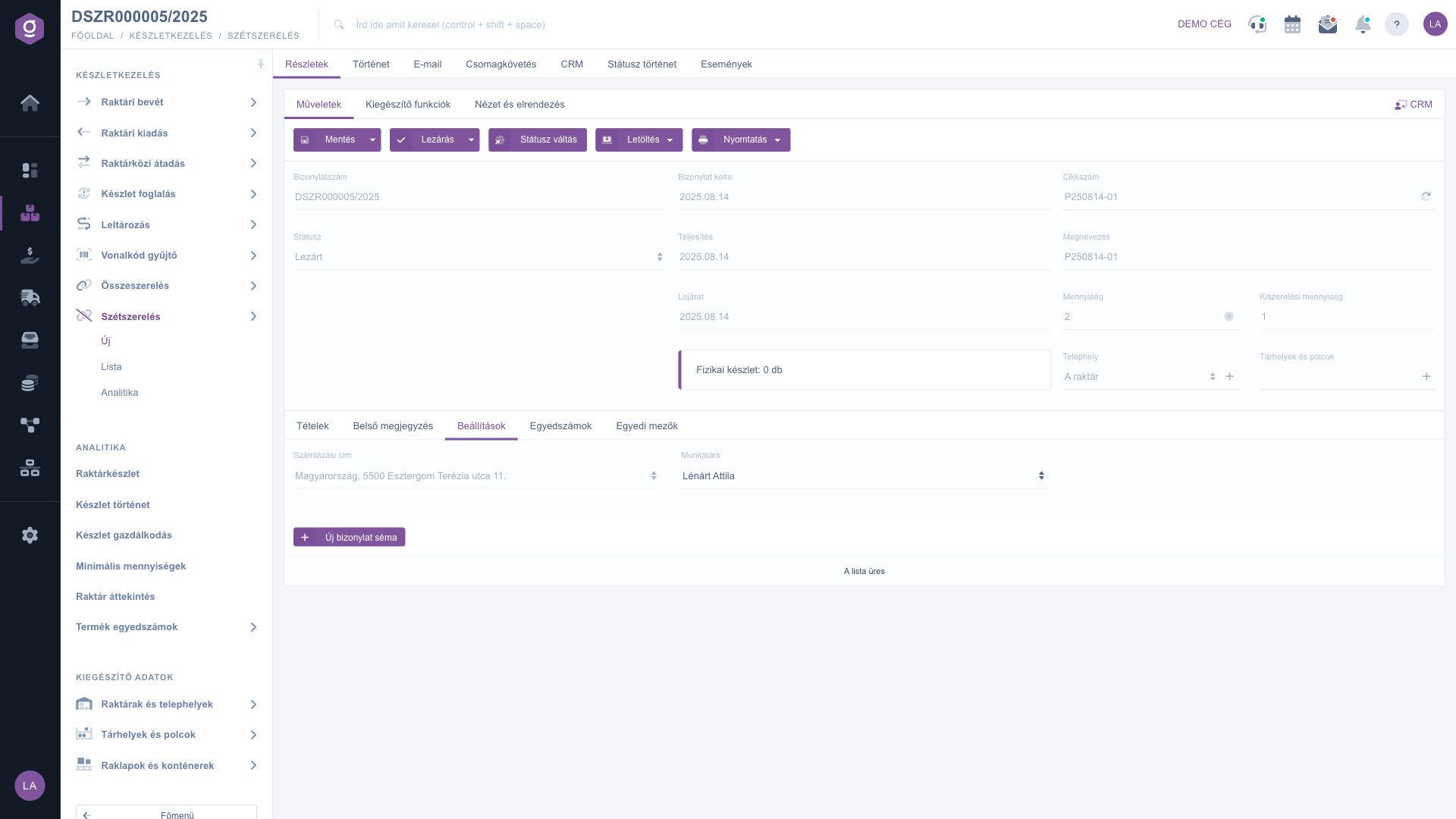
Disassembly document – Settings tab

5. Save and Close

On the Actions tab, the dropdown of the Save button offers Save and Save and close. When saving, the data is recorded, but the document stays in Draft and the stock does not change. The Close button (dropdown: Close, Close and print, Close and download) finalizes the document. On closing:

  • the document gets Closed status;
  • the system automatically creates a warehouse issue, which decreases the stock of the finished product;
  • and a warehouse receipt, which increases the stock of the ingredients.

Only a Draft document can be closed, and after closing the document cannot be modified. If there is not enough of the finished product in stock, closing may stop with an error message: check the Physical stock value and the site.

6. Print, download, status

The Print menu offers the Ingredients printout (the list of parts to be returned, for warehouse work), the Finished product and the full Document. The Download menu gives you a PDF preview and download, and the Status change button changes the status. On a saved document further tabs appear at the top: Details, History, E-mail, Package tracking, CRM, Status history and Events. The Additional functions tab offers the shortcuts New product, New partner, New task and Partner card.
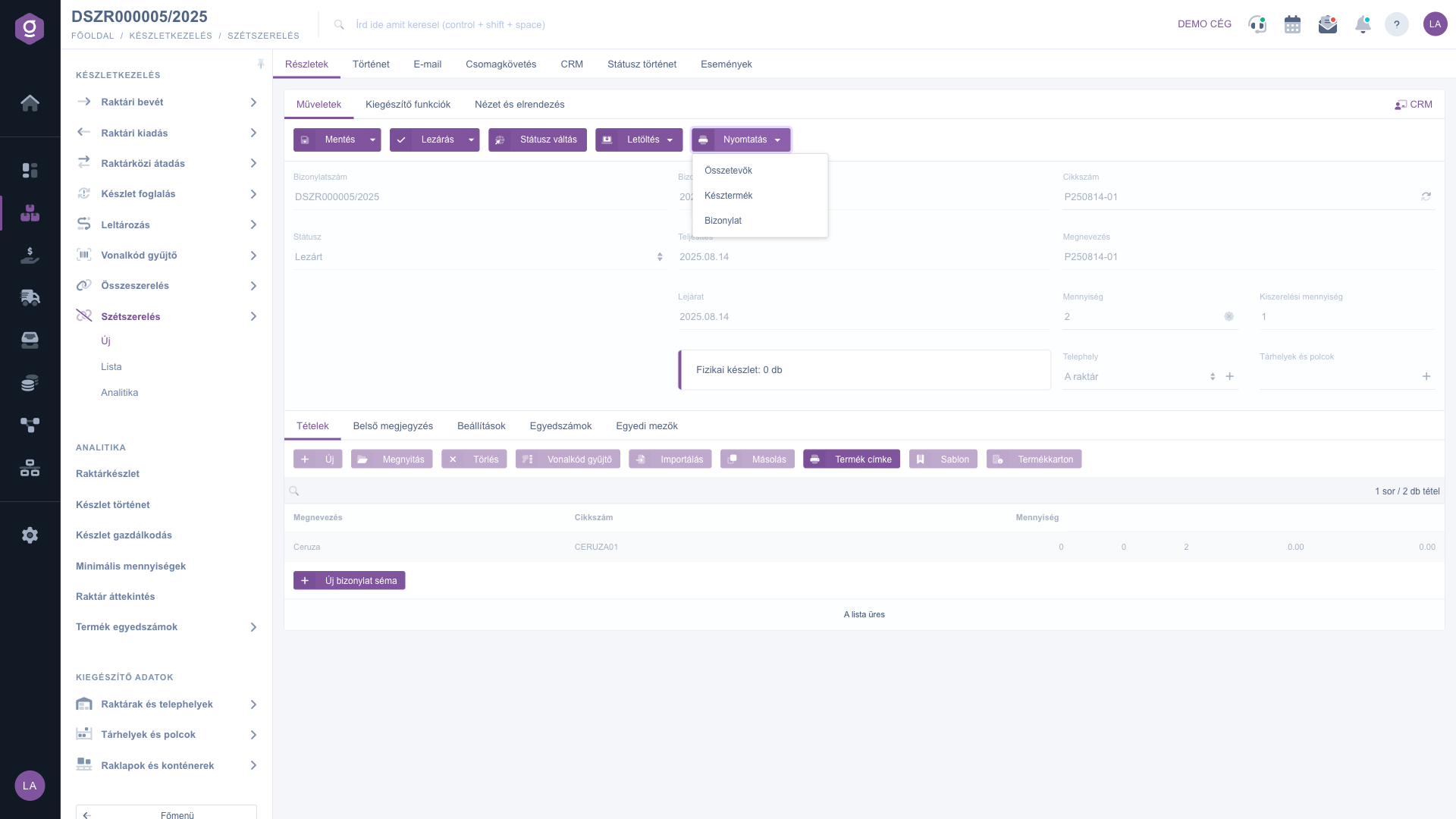
Disassembly document – Print menu

Tip


Before closing, print the Ingredients list and check in the warehouse that the parts really go back on the shelf. If there is a difference, you can still modify the items of the Draft.

For the opposite process, where a finished product is built from its components, read the Assembly document article.

For the stock documents created automatically on closing, read the Warehouse issue document and Warehouse receipt document articles.

Field descriptions

Header fields

Field / ElementRequiredDescription
Document numberGenerated automatically, cannot be changed (e.g. DSZR000005/2025).
Document dateThe day the document was created, automatic.
StatusThe state of the document; managed by the system.
Performance dateDate the disassembly is carried out.
ExpirationExpiration date of the document.
Item numberPart number of the finished product to disassemble; the refresh button next to it reloads the ingredients.
NameName of the finished product; shows a list of results while you type.
QuantityHow many pieces of the finished product are disassembled; the ingredient quantities change in proportion.
Packing quantityQuantity according to the packing unit of the product.
SiteWhere the disassembly takes place; the ingredients return to stock here.
Storage locations and shelvesThe exact storage place of the stock.

Item fields

Field / ElementRequiredDescription
NameName of the ingredient.
Item numberPart number of the ingredient.
QuantityQuantity of the ingredient to return (the quantity in the composition multiplied by the quantity of the document).

Settings tab

Field / ElementRequiredDescription
Billing addressThe address belonging to the document.
EmployeeThe employee who carries out the disassembly; the Analytics report summarizes by this.

Fill in the Employee field so that the disassembly appears in the Analytics report under your name.

Frequently asked questions

From the composition entered on the Ingredients tab of the finished product record. If there is no composition there, you have to add the items manually.

The stock of the finished product decreases (warehouse issue) and the stock of the ingredients increases (warehouse receipt). The system creates both stock documents automatically.

At least one item is required on the Items tab. Select the finished product so that the ingredients are loaded, or add an item manually with the New button. Also check the required fields (Performance date, Expiration, Site).

Only a Draft document can be closed. Closing may also stop if there is not enough of the finished product at the selected site: check the Physical stock value and, if needed, reduce the quantity or change the site.

No, the document can only be edited in Draft status. On closing the document is finalized and no further modification is possible.

Assembly builds a finished product from its ingredients (ingredient stock decreases, finished product stock increases); Disassembly is the reverse.

Need personalized help?

Don't want to spend hours searching for a solution? Choose the most efficient way: book a personalized, 45-minute online training session dedicated entirely to you. Whether it's a walkthrough of the basics or a detailed setup of a specific module, our expert colleague will guide you through the whole process, step by step.

Don't waste your time - ask for help!
Our goal is to get you using our system as quickly and efficiently as possible. Whether you're completely new to us or stuck on a specific setting, don't hesitate to ask for help!

Logzi warehouse management software

Get in touch with us

Interested in our software? Feel free to write to us!

Need help?

If you can't find the answer and need assistance

Create your account now,
pay later!

Try it free for 3 days, no risk, no obligation!