Balance statement sheet

Learn how to put together, save, close, download and send a balance statement from a partner's invoices.

Feature overview

Under Main menu / Cash register / Balance statement / New you create a balance statement for a partner: you choose the partner, add the partner's invoices, and the sheet totals the net, VAT and gross value, the amount already paid and the remaining balance. You can close the finished document, download it as a PDF or send it to the partner by email. You can open an existing balance statement from the Balance statement / List page with the Open button. Note: the screenshots are from the Hungarian interface; Hungarian labels are shown in parentheses in the image descriptions where useful.

  • What does it contain? Header data (currency, performance date, period, partner, partner contact person), the table of added invoices (Items), comments, settings and related documents.
  • Totals: at the bottom of the sheet you see the sum of Net value, VAT value and Gross value, the Paid amount and the Balance (gross value minus paid). They are calculated from the added invoices.
  • Statuses: a newly saved document is a Draft, after closing it is Closed. A closed document can no longer be modified. A deleted document gets the Cancelled status.

Which page to use when?

  • New (this guide): putting together a new balance statement, or opening and handling an existing one.
  • List: finding, filtering and reviewing existing balance statements.

Step by step

1. Opening the sheet

For a new document click Main menu / Cash register / Balance statement / New. For an existing one open the List page, select the row and click Open. At the top of the sheet you see three tabs: Actions, Additional functions and View and layout, and the CRM link on the right. The image shows a closed balance statement, so the editing buttons are dimmed; for a draft they are active.
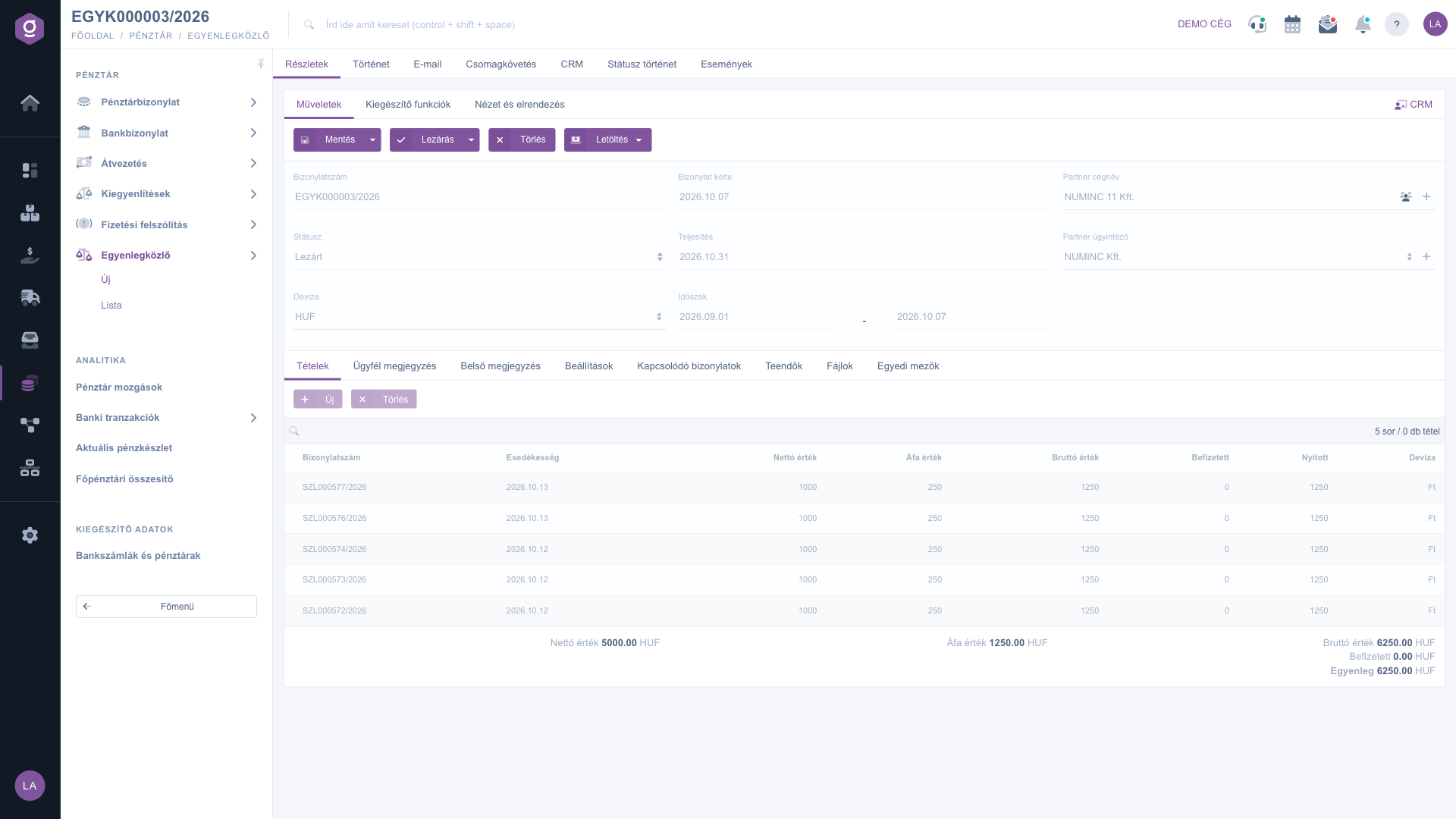
Balance statement sheet – Actions tab (Műveletek)

2. Filling in the header data

Below the tabs you find the header data:

  • Document number, Document date and Status: filled in by the system, not editable.
  • Currency (required): choose the currency of the document.
  • Performance date (required): the day of performance, using the date picker.
  • Period: the start and end of the balance statement period (optional).
  • Partner company name: start typing the partner's name and choose from the results. The buttons next to it open the partner's sheet or let you create a new partner. Once the partner is chosen, the Partner contact person list is filled in; you can also add a new contact person with the + button.

3. Adding invoices on the Items tab

On the Items tab you add an invoice with the New button. Choose the partner first: if none is selected, a warning appears (in the Hungarian interface: "Partner választani kell!", meaning that a partner must be chosen). In the window that opens, pick the partner's invoice from the Document number list and click Add (to leave, use Close). The table shows the invoice data: Document number, Due date, Net value, VAT value, Gross value, Paid, Open and Currency. To remove an unneeded item, select its row and click Delete. The totals at the bottom are updated with every change.
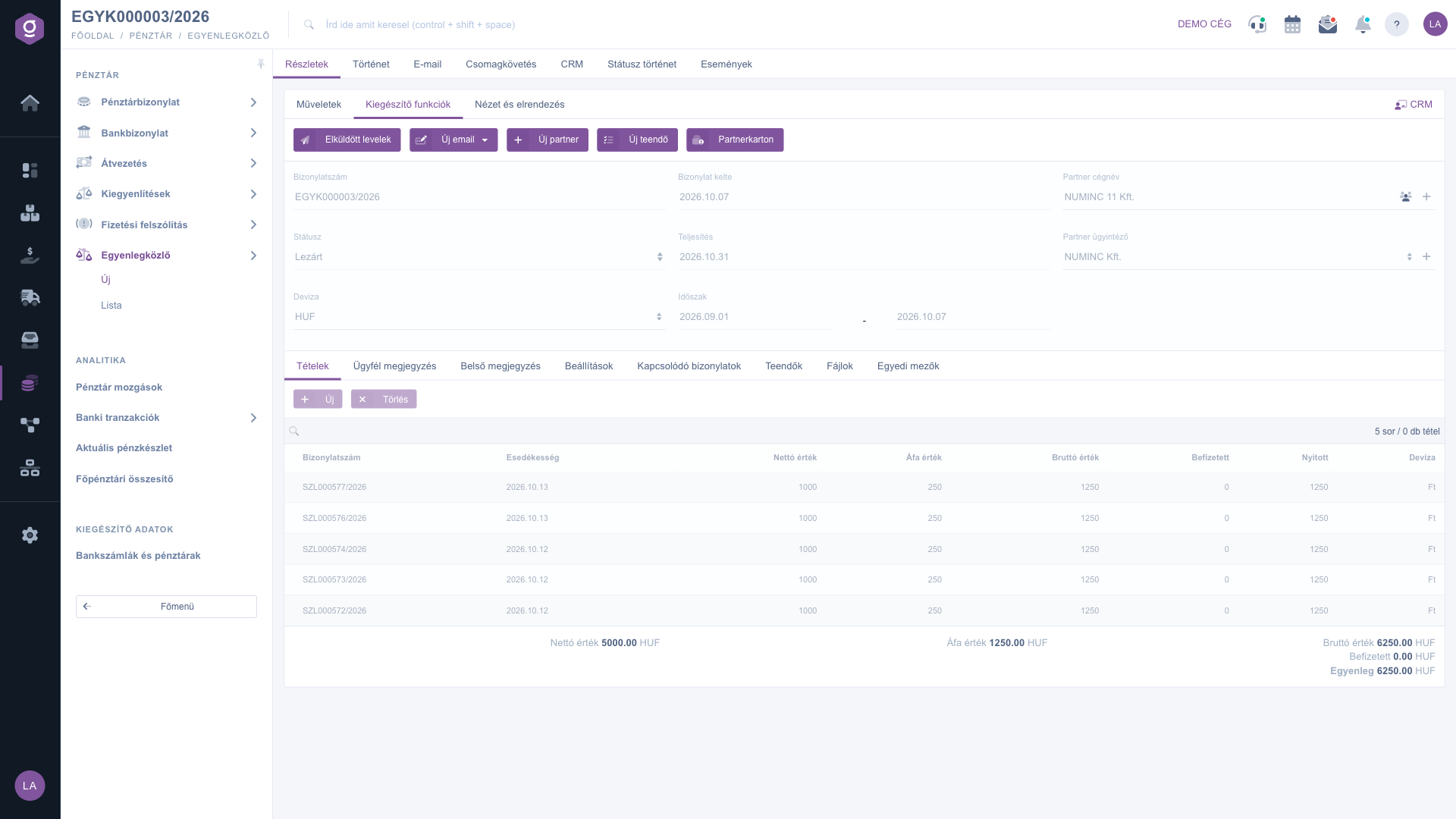
Items tab (Tételek) – the added invoices and the totals

4. Comments and settings

On the Customer comment and Internal comment tabs you can write a comment in a text editor; you can also choose a previously saved comment from the dropdown above. On the Settings tab you set the Billing address (required), the Job number, the Department number and the Template; the + button next to the job number and department number opens a new page to create a new record.
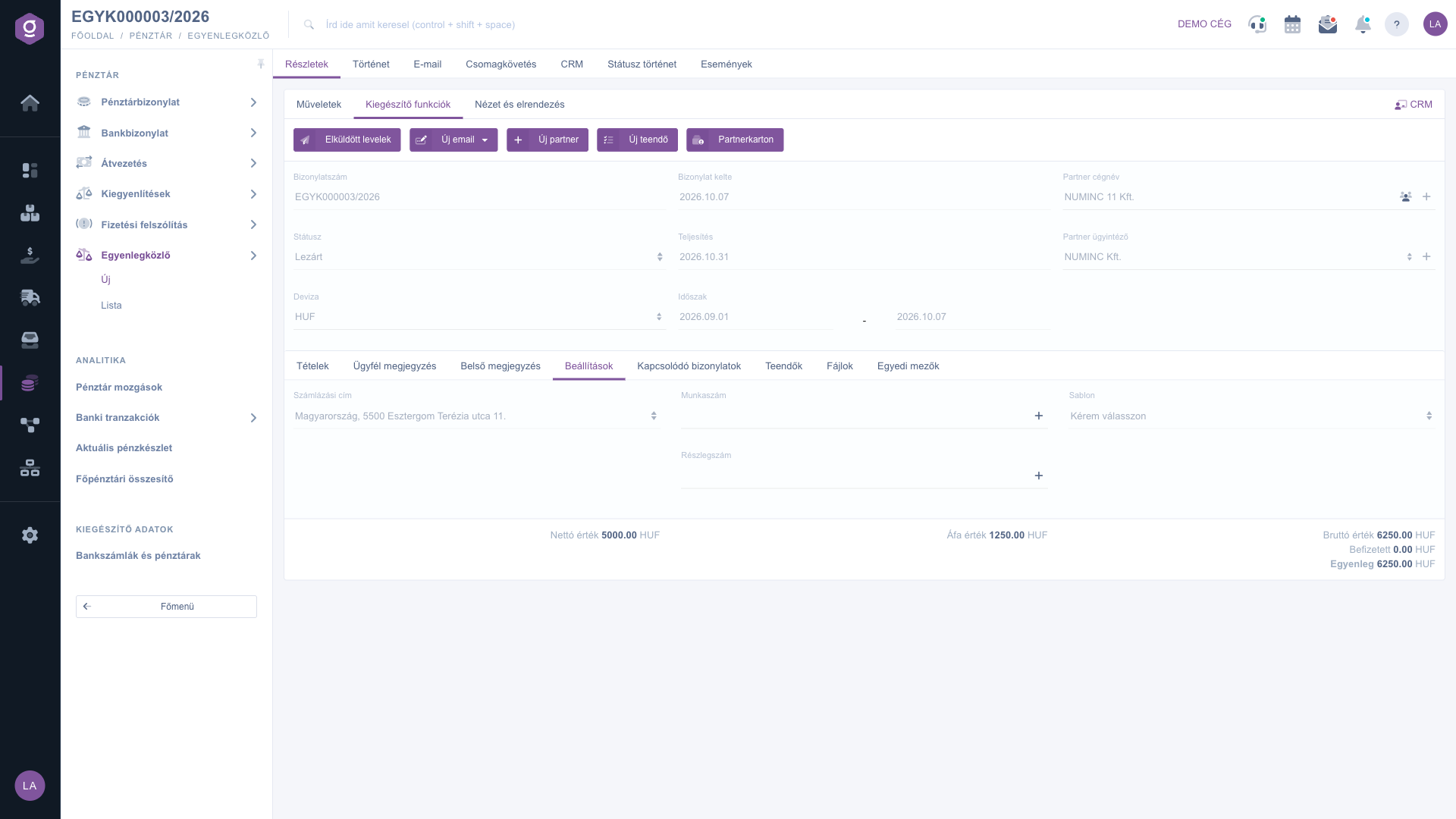
Settings tab (Beállítások)

5. Saving, closing, deleting and downloading

On the Actions tab you find these buttons:

  • Save: records the data; the document stays a draft. The dropdown also offers Save and close. To save, you must add at least one item and fill in the required fields.
  • Close: finalizes the document; afterwards it cannot be modified. The dropdown also offers Close and print and Close and download. It can only be used for a draft.
  • Delete: the document gets the Cancelled status. You can delete both drafts and closed documents.
  • Download: a dropdown with CSV, XLSX, PDF and PDF preview. PDF and CSV are only available for a closed document; XLSX and PDF preview also work for a draft.

6. Additional functions

On the Additional functions tab you find Sent items (only for a closed document), New email (External mail client or Internal mail client), New partner (opens in a new tab), New task and Partner card. On the View and layout tab you find the Interface and behavior settings, and the CRM link on the right opens the notes belonging to the document.
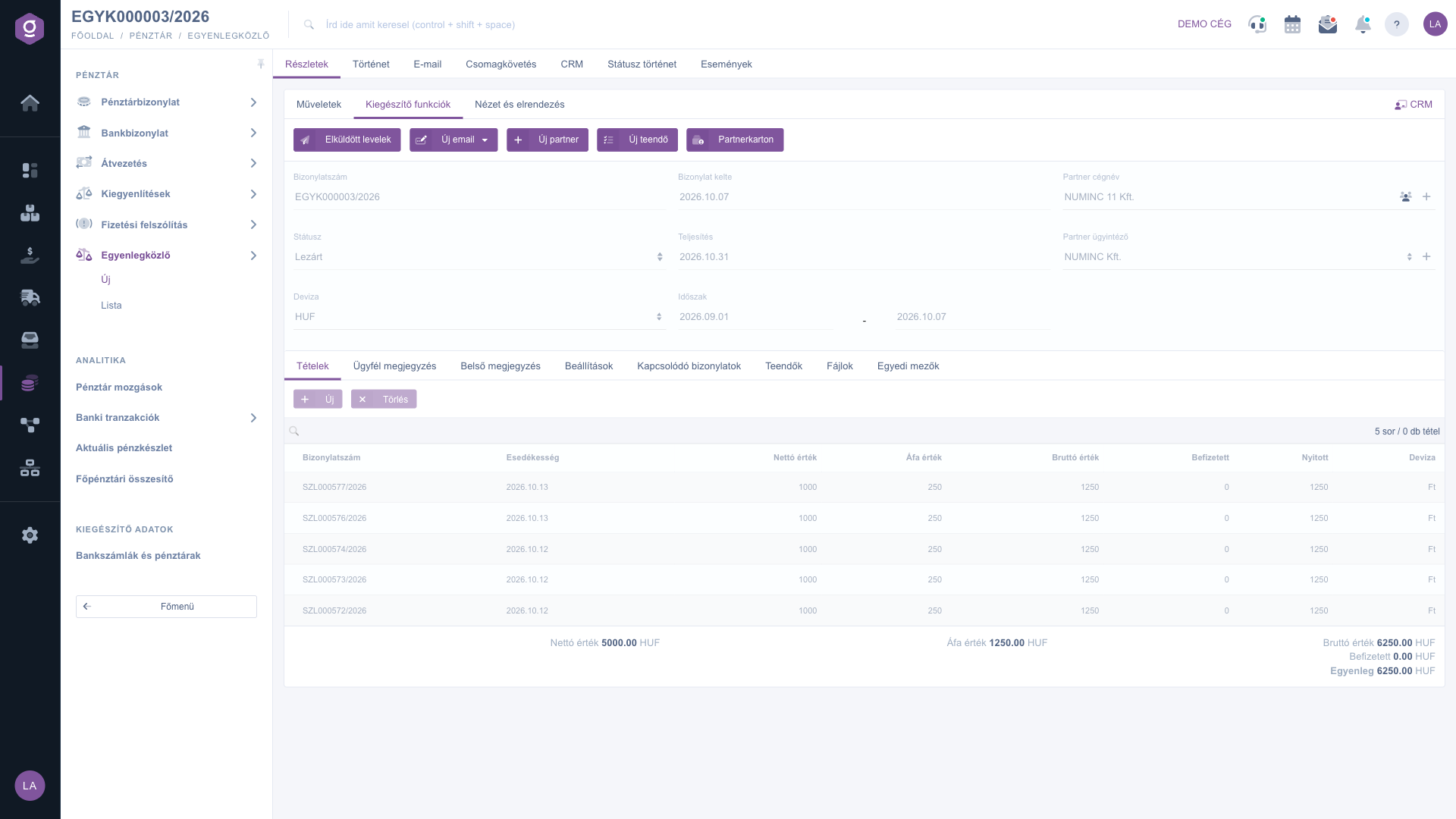
Additional functions tab (Kiegészítő funkciók)

7. Related documents, tasks, files

On the Related documents tab you see the documents the balance statement is linked to (Document number, Document date, Document type, Issuing employee); if there are none, the list is empty. On the Tasks, Files and Custom fields tabs you manage the tasks, attached files and custom fields of the document.
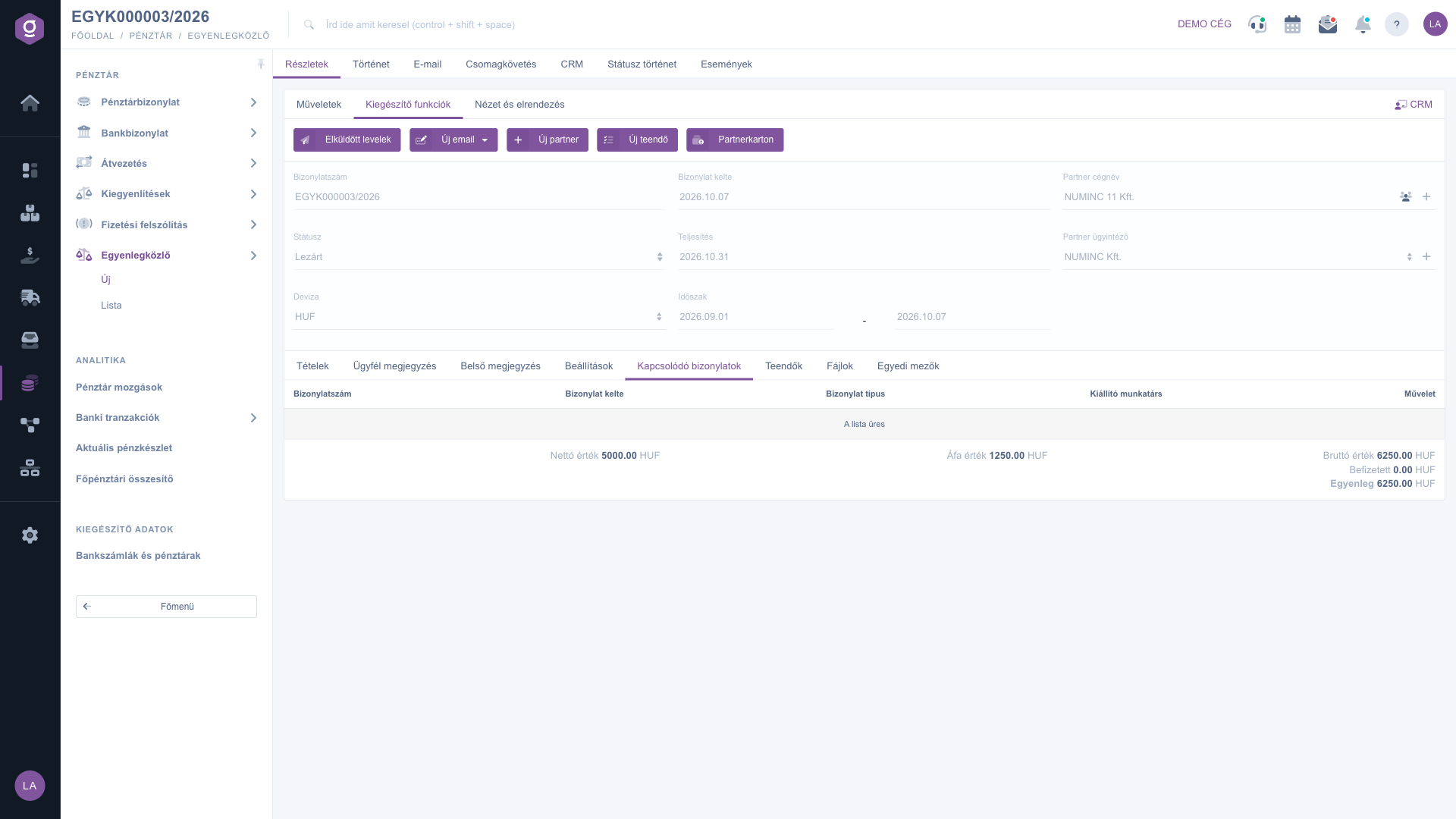
Related documents tab (Kapcsolódó bizonylatok)

Tip


When you save, the data is recorded; finalization happens when you close. First save as a draft, check the items and amounts with the PDF preview, and only then close the document.


You can read about finding and handling existing balance statements in the Balance statement list guide.

Field descriptions

Field / ElementRequiredDescription
Document numberThe identifier of the document; assigned by the system, not editable.
StatusDraft, Closed, Cancellation or Cancelled; not editable.
Document dateThe day the document was created; not editable.
CurrencyThe currency of the document.
Performance dateThe day of performance.
PeriodThe start and end of the period (two dates).
Partner company nameThe partner the balance statement is made for. It must be chosen before you can add an invoice.
Partner contact personThe contact person chosen at the partner.
Items (Document number)At least one added invoice is needed to save.
Customer comment, Internal commentFree-text comments, with the option to choose a previously saved text.
Billing addressYour company's billing address on the Settings tab.
Job number, Department numberMaster data that can be searched by typing; you can create a new one with the + button.
TemplateThe print template of the document.

The columns of the Items table (filled in from the invoice data, not editable):

Field / ElementRequiredDescription
Document number, Due dateThe identifier and payment deadline of the added invoice.
Net value, VAT value, Gross valueThe values of the invoice.
PaidThe amount already recorded as settled against the invoice.
OpenThe difference between the gross value and the paid amount.
CurrencyThe currency of the item.

Frequently asked questions

There are two possible reasons. If no partner is selected, a warning appears: first choose a partner in the Partner company name field. If the document is already closed, the items cannot be modified and the New and Delete buttons are dimmed.

To save the document you must add at least one item (invoice) and fill in the required fields: Currency, Performance date and, on the Settings tab, the Billing address. If any of these are missing, the document is not saved.

PDF, CSV and Sent items are only available for a closed document. For a draft, close the document first; until then you can use PDF preview and XLSX.

After closing, the document is finalized and no further modification is possible. If it is wrong, you can delete it with the Delete button (it gets the Cancelled status) and create a new one.

When you add an invoice, the system fills them in from the invoice data: Paid is the amount already recorded as settled against the invoice, Open is the difference between the gross value and this. When you save, the totals of the balance statement are recalculated from the current data of the invoices.

Need personalized help?

Don't want to spend hours searching for a solution? Choose the most efficient way: book a personalized, 45-minute online training session dedicated entirely to you. Whether it's a walkthrough of the basics or a detailed setup of a specific module, our expert colleague will guide you through the whole process, step by step.

Don't waste your time - ask for help!
Our goal is to get you using our system as quickly and efficiently as possible. Whether you're completely new to us or stuck on a specific setting, don't hesitate to ask for help!

Logzi warehouse management software

Get in touch with us

Interested in our software? Feel free to write to us!

Need help?

If you can't find the answer and need assistance

Create your account now,
pay later!

Try it free for 3 days, no risk, no obligation!