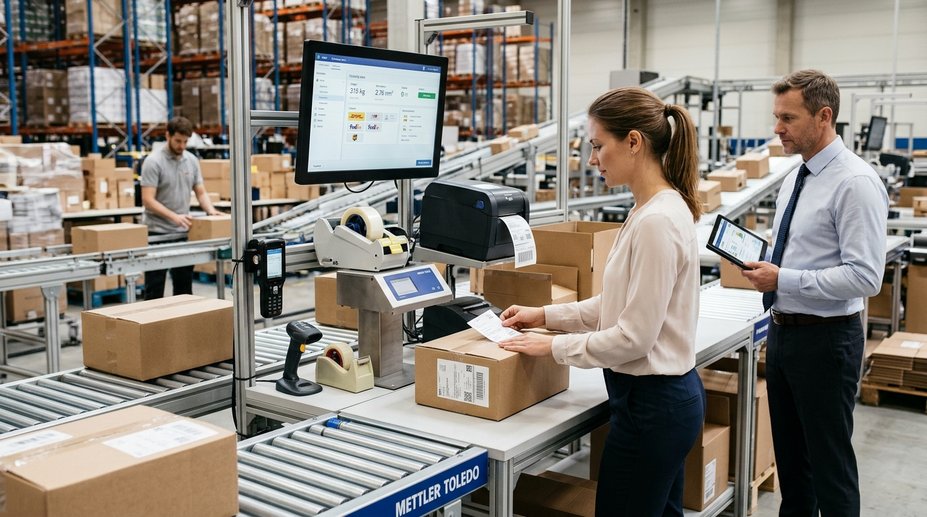
Automate Shipping Data & Scale Warehouse Fulfillment
Modern fulfillment demands absolute accuracy and speed at every step of the packing line. By uniting an advanced parcel dimensioning system with precise automated weight capture, growing brands can completely eliminate carrier dimensional surcharges and shipping delays. Upgrading your core enterprise resource planning platform with real-time freight data synchronization is the ultimate key to achieving flawless logistics workflow efficiency.
The Hidden Costs of Manual Parcel Data Entry and Volumetric Surcharges
In high-throughput fulfillment hubs across North America and Europe, manual measurement of cartons remains one of the largest silent profit killers. When warehouse operators manually measure boxes with tape measures and key weights into isolated carrier portals, error rates skyrocket. Over-declaring parcel size wastes hard-earned gross margins, while under-declaring size results in steep post-shipment carrier adjustments and penalty fees from major parcel networks.
Major freight and parcel carriers rely heavily on dimensional weight calculation to optimize container density and cargo plane capacity. If your warehouse relies on static estimate charts or guesswork, you are constantly paying extra for billing dimensional adjustments. According to recent industry analytics from the Pitney Bowes Parcel Shipping Index, global parcel volumes continue to climb alongside rising volumetric freight rates, making accurate dimensional reporting vital for cost control.
Achieving true packaging process optimization requires moving away from manual metrics collection. Automated dimensioners and inline scales eliminate human error by recording physical payload dimensions down to millimeter precision within milliseconds as packages move down the conveyor line.
Bridging Warehouse Operations and Carriers via Courier API Integration
Capturing accurate weight and dimension data is only half the battle; the true operational magic occurs when that data streams instantly into your central software ecosystem. Modern logistics infrastructures depend on tight courier API integration between your core warehouse management system (WMS), enterprise platform, and multi-carrier shipping systems.
Without automated data pipelines, workers must re-key weight and size data into separate carrier software applications (such as FedEx Ship Manager or UPS WorldShip). This disconnected workflow creates massive fulfillment bottlenecks during peak demand periods. Direct API connectivity enables instantaneous exchange of parcel metrics, allowing instant rating, rate shopping, and automated label generation in a single touchpoint.
Furthermore, automated shipping process automation ensures that customs documentation, commercial invoices, and bill of lading (BOL) forms are dynamically generated based on verified physical metrics, eliminating border delays for international freight shipments.
Modern ERP Trends: Centralizing Logistics Data for Full Operational Visibility
As enterprise resource planning (ERP) solutions evolve, the line between core inventory management, financials, and physical warehouse operations has blurred. Leading mid-market enterprises are actively retiring fragmented, legacy software stacks in favor of unified ERP platforms that natively process physical hardware metrics directly on the packing floor.
A recent study on digital transformation by McKinsey & Company highlights that supply chain operators prioritizing end-to-end automation and real-time data visibility achieve up to 30% lower operational expenditure compared to non-automated peers. Modern ERP systems now act as the central nervous system for fulfillment, translating real-time floor metrics into financial clarity, automated reordering thresholds, and immediate customer notification workflows.
When automated dimensioning systems communicate directly with your ERP, inventory data is enriched instantly. The system learns the exact volumetric displacement of every stock-keeping unit (SKU), optimizing future cartonization rules and packing recommendations to reduce void fill packaging waste.
7 Practical Steps to Optimize Your Shipping and Dimensioning Workflow
Ready to modernize your dispatch operation and eliminate carrier adjustment penalties? Implement these practical, action-oriented logistics strategies within your facility today:
- Deploy Automated Dimensioning and Weighing Systems (DWS): Integrate dynamic or static inline scales combined with volumetric optical scanners to capture precise package metrics instantly, eliminating manual entry errors.
- Establish Direct API Integration with Freight Carriers: Connect your Enterprise Resource Planning (ERP) or Warehouse Management System (WMS) directly to carrier APIs (such as FedEx, UPS, or DHL) to push captured payload metrics seamlessly in real time.
- Standardize Box Sizes and Packaging Profiles: Maintain a pre-configured database of standard carton dimensions within your shipping software to streamline dimensional weight calculations and reduce dimensional billing surcharges.
- Automate Instant Shipping Label Generation: Configure system triggers so that validated weight and dimension data instantly generates accurate shipping labels and customs documentation upon package verification.
- Implement Automated Quality Audit Thresholds: Set software alert parameters for unexpected weight or dimension variances to catch packing errors or missing items before handing off parcels to the carrier.
- Leverage Automated Multi-Carrier Rate Shopping: Use exact captured weight and size data to query multiple carrier rates simultaneously, automatically selecting the most cost-effective delivery service for each shipment.
- Continuously Monitor Metrics and Audit Carrier Invoices: Track throughput speed and audit post-shipment carrier adjustment fees against system logs to identify fulfillment bottlenecks and refine logistics workflows continuously.
Maximizing Throughput with Automated Label Generation and Rate Shopping
Speed on the packing floor translates directly into faster delivery times and higher customer satisfaction scores. When an operator places a packed box onto a scale equipped with a parcel dimensioning system, automated software should perform background rate shopping across pre-negotiated carrier contracts within fraction of a second.
By evaluating exact package volume alongside precise scale data, smart algorithms automatically select the service level that balances delivery speed with minimum freight cost. Once selected, automated label generation immediately prints the compliant carrier shipping label, packing slip, and hazmat declarations without requiring manual keyboard clicks.
This streamlined process drastically reduces operator training time, minimizes physical touchpoints, and protects your business from shipping margin erosion caused by miscalculated carrier fees.
Building a Resilient Logistics Infrastructure with Logzi ERP
Scaling your fulfillment operations without dramatically increasing headcount requires smart, integrated technology tailored to mid-market enterprise needs. Logzi ERP bridges the gap between hardware equipment on your packing floor and complex financial, inventory, and carrier management workflows. By centralizing automated weight capture, dimensional rating calculations, direct courier API connections, and real-time inventory updates into a unified dashboard, Logzi ERP empowers growing businesses to dispatch orders faster, eliminate shipping chargebacks, and maximize everyday profitability. Elevate your warehouse fulfillment today and unlock effortless operational growth with Logzi ERP.